
Last Night @ School Committee

A bite-sized summary of Boston School Committee meetings, and "Deep Dives" on the biggest issues impacting public schools nationwide.


Boston School Bus Failures & BPS's Incomplete Strategic Plan
Last Night @ School Committee September 16th, 2026
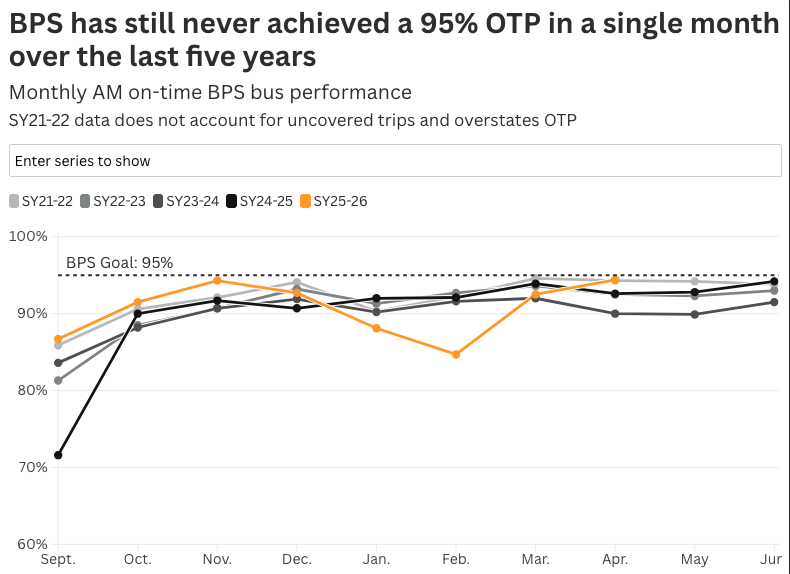
At last night's Boston Public Schools School Committee meeting, the Superintendent reported strong first-day numbers, including improved bus on-time rates, rising attendance, and all previously displaced teachers now placed in permanent positions. That was quickly undercut by two parents who testified about serious transportation failures, including children stranded on buses for hours with no help from the district. The meeting also touched on a new Inspector General report on procurement problems, which prompted a payment pause and a review, an update on the long-term Madison Park vocational school rebuild that isn't expected to finish construction until around 2033, and public comments pushing for more advanced coursework access, faster action on Madison Park, clearer measurable goals, and support for families navigating the special education process.
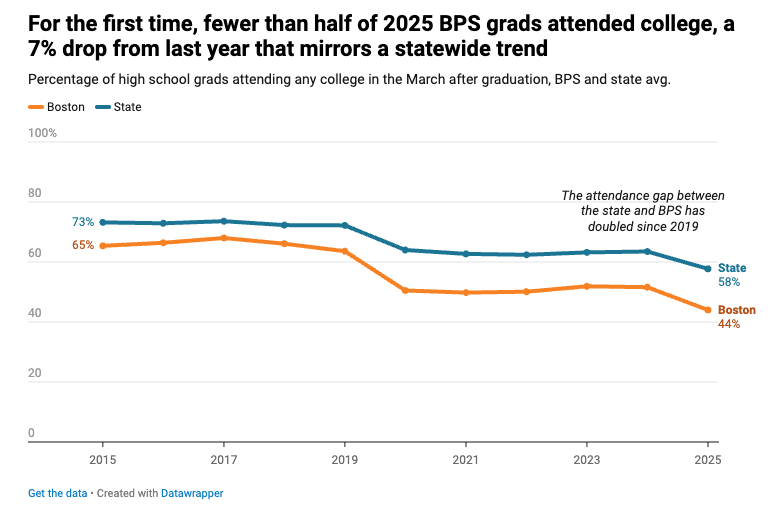
The evening ended with the district presenting its five-year Strategic Roadmap, which committee members criticized as vague and lacking concrete, measurable targets. Several pushed back and asked for real benchmarks instead of broad goals. Grants and donations passed unanimously, and a charter school agreement was presented but held for a future vote. Since the last meeting, we've seen a number of data drops and educational updates that we've further detailed in our post. That includes the final recommendations for the new statewide graduation standards, which fall short of meeting the moment. New absenteeism data shows uneven progress, and persistently high chronic absenteeism in Boston's high schools. A brand new survey of Massachusetts educators highlights how problems in the classrooms dominate teacher concerns. Finally, we help out the district by providing some actual targets for their proposed Strategic Roadmap.
Tools
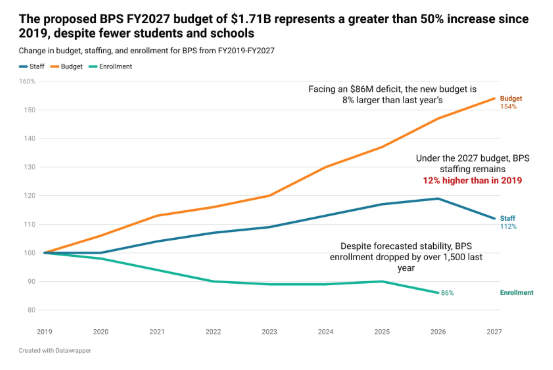
The 2027 proposed budget for Boston Public Schools is over $1.7B, providing funding for over 10,000 employees responsible for more than 46,000 students across 105 schools. Comprising over 40% of the city’s budget and shouldering responsibility for educating tomorrow’s leaders, understanding the changes in the budget are crucial. The district makes many of its financial documents publicly available, although not always in an accessible or easily understandable format. The tool below combines multiple sources of data (chiefly the FY27 budget sheet and the budget book) in an easily browsable format to help students, teachers, policymakers, and concerned citizens to understand the changes in the coming fiscal year.
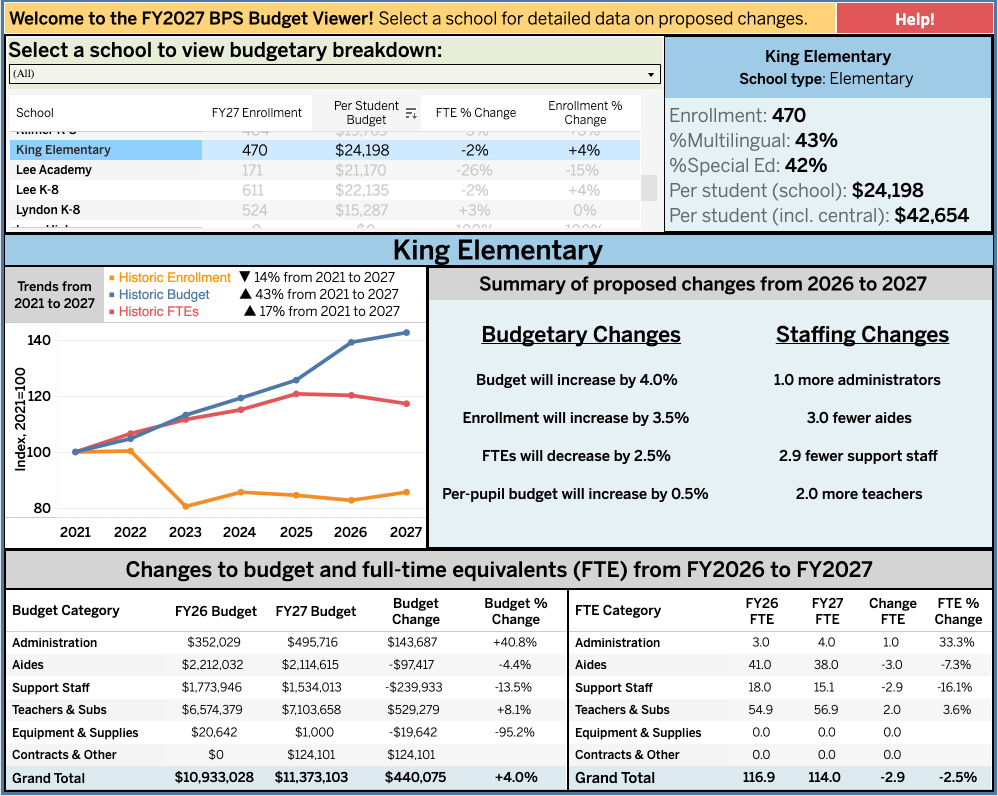
School Database allows you to explore enrollment, budget, and staffing changes for individual schools from 2026 to 2027. The dashboard shows district-wide changes, and searching for or clicking on individual schools in the list will bring up school-specific data.
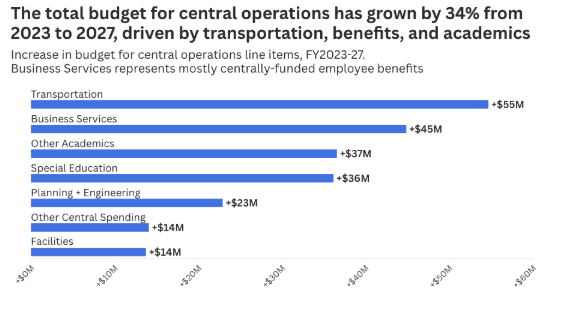
BudgetBreakdown details how the FY2027 budget is spread between direct school funding and central office funding, and how each broad category and specific line item is changing. Hovering over each box provides more information, and filters on the right allow for a closer view.
Budget Over Time will detail how each broad budget category has changed since 2019, and which portions of the budget have grown the fastest.

Methodology
Numbers may vary slightly from sources elsewhere. While it may be an error, it’s also possible that the underlying data has variations from source-to-source. As this tool attempts to unify disparate sources across times and departments, variation is a given. Some of the more common questions sources of inconsistency:
School inclusion: BPS, in its budget, includes a number of in-district charters (Boston Day and Evening Academy, Green Academy, Dudley Street Neighborhood School, and the Kennedy Academy for Health Careers) which are sometimes excluded from datasets. Given that these are funded and staffed by BPS, they are included here. School names and formats change over time, and while we strive to be consistent, this can create confusion.
Enrollment: This total varies based on when the students are counted, and totals in the beginning and end of the year may vary. As mentioned above, the inclusion of in-district charters can also add several hundred students.
Budget: We use the most recent FY27 budgets, but these are still subject to change and may vary between draft budgets. For historic budgets, we use current spending levels as opposed to adopted budgets, which can lead to variation.
Budget category: To create cross-time comparisons in the budget breakdown, we have attempted to group central budgeted functions as they are in the FY27 budget, as they were grouped differently in years past. These groups are unofficial, and while all individual line items remain as they appear, the category in which they appear may be unexpected.