A Look at BPS's FY2027-2031 Capital Plan and the District's Facility Quality Gap | Last Night at School Committee: April 15, 2026
Last night’s School Committee meeting touched on a number of critical issues for BPS, including a vote on a policy amendment to MassCore, an ask for more money to fill a budget gap, an update on decade old policy surrounding opportunity and achievement gaps, a new strategic roadmap, as well as an an approval for a new MSBA statement of interest. To learn more about these topics, please listen to the podcast for more in-depth analysis. Regarding BPS facilities, which played a key role at the start of last night’s meeting, we conducted an analysis to better understand the future of the district’s capital plan in the coming years. Read more, below:
FY2027-2031 Capital Plan
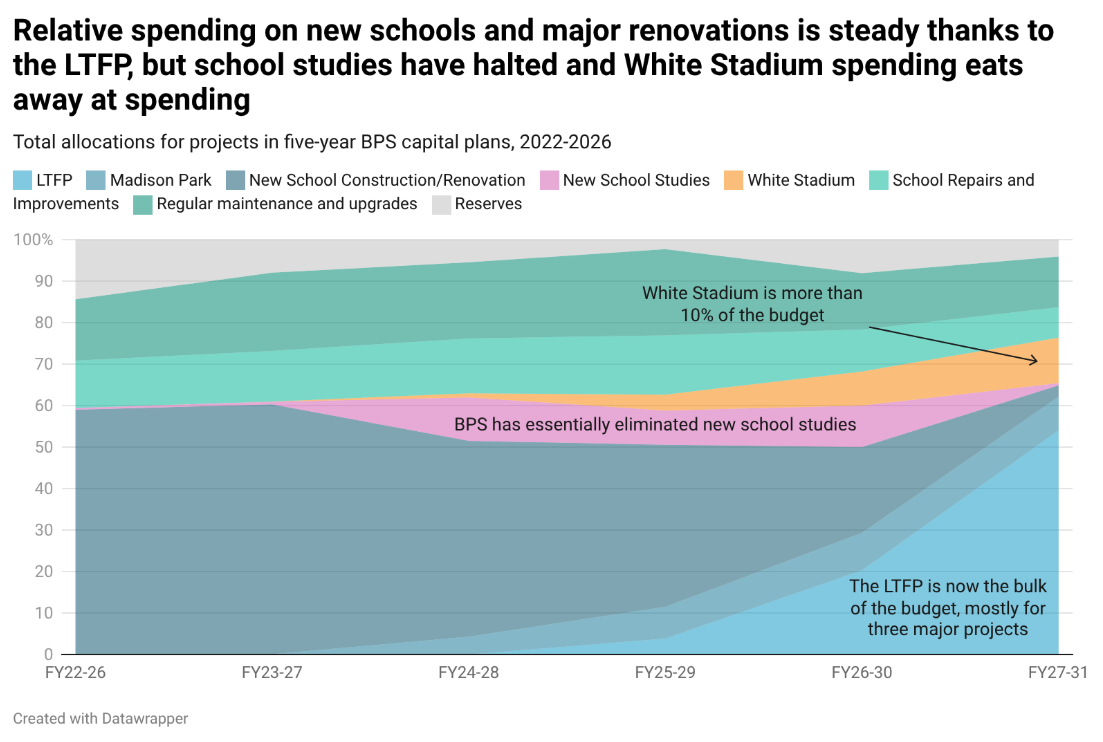
Last week, the City of Boston released its FY2027-2031 capital plan, outlining the $4.4B in projects it will undertake over the next few years. BPS’s share of the capital budget is $1.23B or 28%, the highest proportion it has received since at least the FY2022 plan. Since that year, BPS’s capital plan has grown from $741M to over a billion thanks to additional city investment on the heels of Mayor Wu’s 2022 “Green New Deal for Schools” promise to invest billions in improving the district’s buildings, aspiring to have ‘fully redone every school building’ by 2032. While spending has increased and the district has opened a number of new or fully renovated schools, the cost and time needed bring into question the feasibility of this goal.
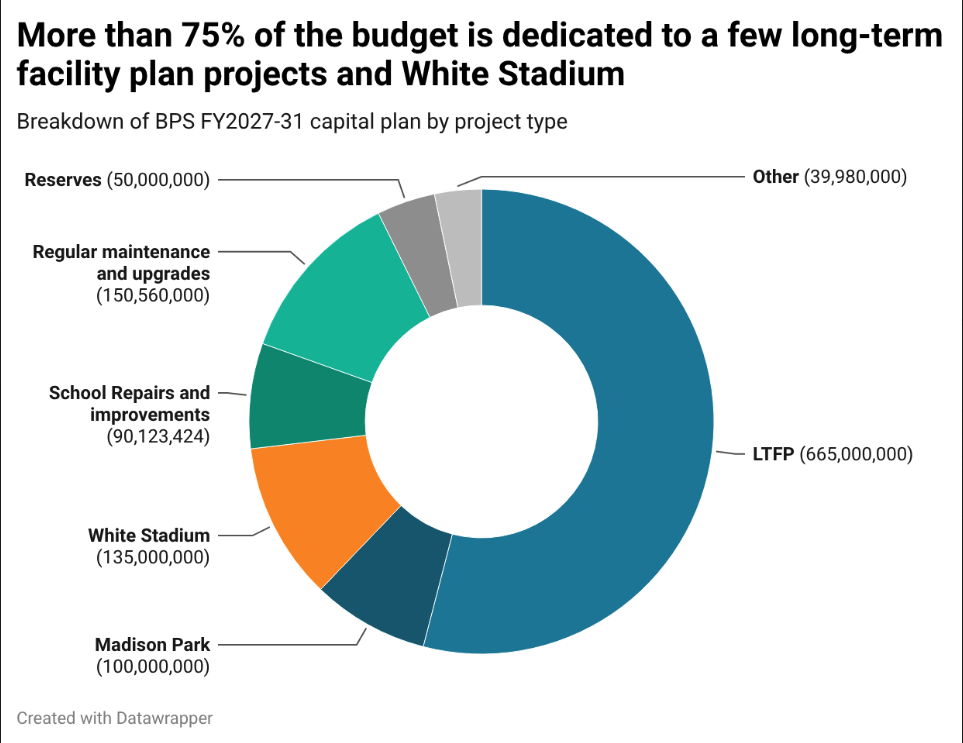
In the latest 2027-2031 capital budget, 65% of the spending is dedicated to major school renovations or building new schools through the Long-Term Facilities Plan (LTFP) and additional funding from the Massachusetts School Building Authority (MSBA). However, only three school projects (Madison Park, Shaw-Taylor, and Ruth Batson) are currently slated to move forward with the current $900M+ in budgeted spending. That cost is likely to rise given Madison Park’s predicted $700M+ pricetag, as it is currently budgeted for just $100M, although some of the $665M budgeted for LTFP will be used for it. While the final capacity of the Ruth Batson is not known, the other two projects (currently slated to finish in the 2030s) have a total capacity of 3,000 students. Along with White Stadium, for which the city’s share has nearly tripled to $135M over the last few years, these projects make up 76% of the capital budget, leaving little room for fiscal flexibility or other major projects.
Since Mayor Wu took office, three new schools have been completed, all of which began under her predecessor. Those were the Boston Arts Academy, Carter School, and Josiah Quincy Upper School, which together have capacity for 1,200 students. Built with the help of MSBA funding, BPS allocated $470,000,000 in capital funding, coming out to over $390,000 per new seat created. Each of these projects were the most expensive MSBA projects in state history per square foot at the time they went to bid. The Boston Arts Academy cost 33% more than the state average in 2021. Quincy Upper was set to cost $1,000 per sq. ft., 53% higher than the state average 2022. At these costs, it becomes increasingly difficult to see how BPS will be able to afford any new projects, especially since municipalities are limited in the number of MSBA projects in the pipeline at any one time. With BPS’s three current MSBA core projects (and a potential fourth with the Mel King, announced at the Committee meeting), it is unlikely that the district will be able to secure more major funding until those projects are completed. When unable to secure MSBA funding, the district often drops renovation plans, as was done with Otis and Blackstone, or the Community Academy of Science and Health, which later closed. The district has completed just two self-funding major renovations for the Horace Mann and Philbrick-Sumner merger, totaling $137M for 1,100 in new capacity ($125,000 per student seat).
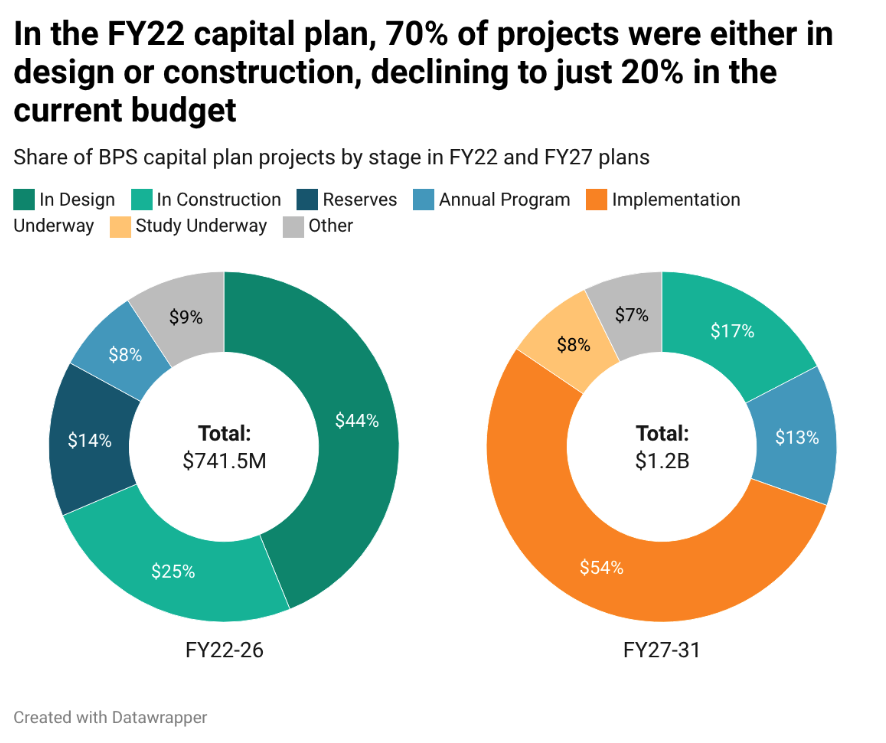
The pace of projects has also slowed dramatically. The capital budget categorizes projects by their status: ‘annual program’ and ‘reserve’ represent ongoing commitments (regular maintenance, replacement) or funds held for future projects. ‘Study’, ‘in design’, and ‘in construction’ represent the progress of major projects. In 2022, more than 70% of funds were allocated to projects in design or construction – including the Carter, Quincy, and Arts Academy. However, that total has dropped to just 20% of the new budget, most of which is for White Stadium. Instead, projects are overwhelmingly studies (a pre-planning phase), or ‘implementation underway’. The latter category is largely for ‘Improvements at several school buildings as part of implementation of the Long Term Facilities Plan, as well as a strategic reserve for MSBA Core projects,’ which the budget does not break down further. However these funds are likely overwhelmingly reserved for the three major school projects once they begin, as well as some funds for smaller renovations. But either way you cut it, by dollar spent or total projects, BPS is actively building less than it has in years while spending more than ever. Given the enormous number of students still in schools with ‘low quality student experiences’ and the near expiration of the current Long-Term Facilities Plan, there are serious questions as to how the district will move forward.
BPS Facility Quality and Planning
The district released the Long-Term Facilities Plan in 2024 in order to address the district’s physical footprint and to achieve what BPS calls a ‘High-Quality Student Experience". This plan involves expanding the district’s footprint with new schools and major renovations, and merging and closing some lower quality schools. The district has seen mixed results at a high cost for the former, but more success with the latter as it has closed a dozen schools over the past several years. Despite this, nearly half of all students still attend schools that the district says provide an inadequate learning experience.
As a part of the LTFP, the district assigns each school building a ‘Building Experience Score’ from 0 to 4, which rates a number of physical, educational, support, and community metrics to evaluate if it is a high-quality experience. Schools with scores 0-2 are inadequate and BPS aims to either improve or close them. This is much complicated by the geographic spread and grade level of each school, and ongoing enrollment struggles. As it currently stands, BPS has capacity for 52,000 students against a current enrollment of 46,000. This is not evenly distributed, some schools are vastly overenrolled (Sarah Greenwood K-8 is at 168% of its capacity) or underenrolled (Condon K-8 is less than 50% capacity). But of these 52,000 seats, just 53% are in schools rated a 3 or 4. The district currently only has 27,600 quality seats for 46,000 students – over 48% of children still attend schools the district calls low-quality!
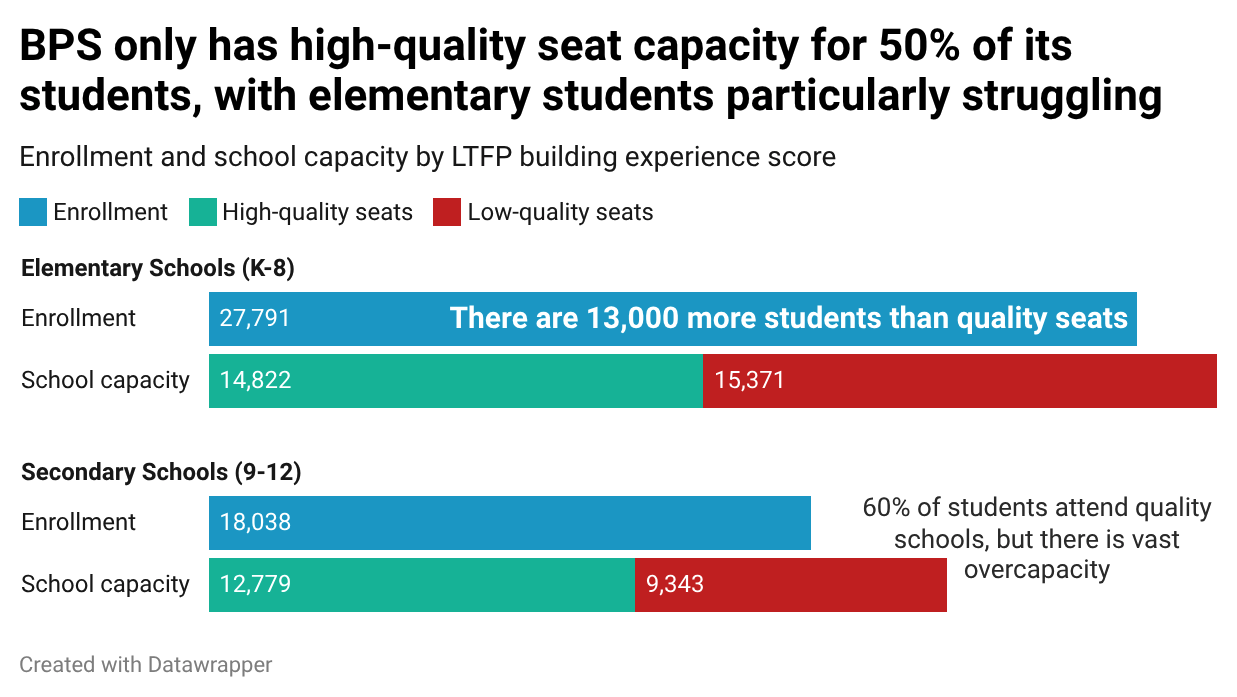
This is an enormous gap to close. The new schools and major renovations over the last five years only created 2,300 seats. The three new projects, years from completion, may double this, but tens of thousands of students will still be unable to access high-quality school seats. The long-term facilities plan currently ends in 2029, with a few more school closures planned but no other major renovations. Amid ongoing budget crunches with the city and BPS, who has requested another $23M in operating budget, it is crucial for the district to outline how it plans to bring all its facilities up to par. BPS needs to present a new facilities plan, one that addresses all schools and all students, and that sets realistic and achievable goals for the near future.
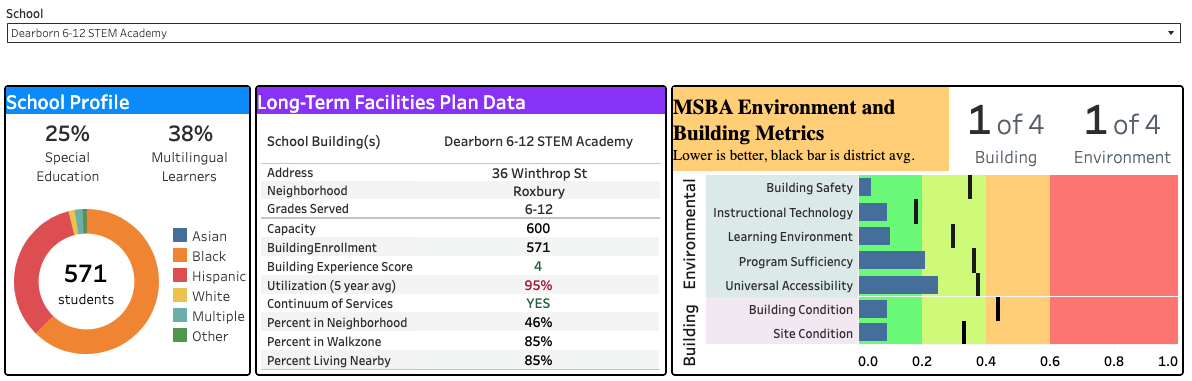
To help better understand the struggles that BPS facilities are facing, we are working on a new tool to go along with our existing budget tool. It will allow users to view each school and key information about its condition, uniting data from BPS the MSBA, highlighting schools at risk of closure based on the district’s own metrics, and other key achievement and management trends. See below for a teaser: