

Search episodes and show notes:
Grading Skipper's Evaluation: What the Data Really Shows | Last Night at School Committee July 8th 2026
Last night's School Committee meeting kicked off with some key updates from Superintendent Skipper. She started off by breaking down the district’s plan to cut around 568 positions. She explained this is a direct response to losing roughly 3,000 students over the last two years, though she promised a steady 10-to-1 student-to-teacher ratio would remain.
Last night's School Committee meeting kicked off with some key updates from Superintendent Skipper. She started off by breaking down the district’s plan to cut around 568 positions. She explained this is a direct response to losing roughly 3,000 students over the last two years, though she promised a steady 10-to-1 student-to-teacher ratio would remain. The Superintendent also touched on summer programming across the district, including the statistic that thousands of students are enrolled in credit recovery, which she framed as a positive sign for students, even though this would mean that more students are failing courses. Skipper also announced that Boston is joining the massive nationwide lawsuit targeting tech giants like Meta, TikTok, and other corporations for harming kids' mental health through social media. During public comment, the only two speakers of the night called out the district for withholding promised exam school outcome data and demanding clear, measurable goals to track student success. Later on, the Committee conducted a marathon voting session, voting on and approving 19 items! These include collective bargaining agreements, grants, private school applications, evaluations, and appointments.
The district's changing infrastructure and facilities footprint dominated the rest of the night. Chief of Capital Planning, Delavern Stanislaus, noted that the district aims to downsize from its original 114 schools to an even 100 by the end of the 2026–2027 school year, with a final target of 95 schools by 2030.
Postsecondary struggles: Fewer than 50% of 2025 grads are attending college | Last Night at School Committee: June 10th, 2026
Last night’s Boston School Committee meeting covered a wide range of issues, beginning with Superintendent Mary Skipper’s report on the district’s ongoing budget concerns, staffing updates, teacher diversity, as well as the implementation of a new cell phone policy. While district leaders highlighted student achievements and positive developments across Boston Public Schools, the public comment period created an emotional reaction focused on proposed changes to the Students with Limited or Interrupted Formal Education (SLIFE) program. Teachers, advocates, and families passionately defended the program, emphasizing its critical role in supporting English learners whose formal education has been interrupted by circumstances such as displacement or political instability. Speakers argued that reducing SLIFE services would disproportionately impact some of the district’s most vulnerable students and raised broader concerns about whether budget pressures are beginning to undermine the exact programs designed to close achievement gaps. Additional testimony focused on challenges families face navigating special education placements and accessing appropriate supports for students with disabilities.
Last night’s Boston School Committee meeting covered a wide range of issues, beginning with Superintendent Mary Skipper’s report on the district’s ongoing budget concerns, staffing updates, teacher diversity, as well as the implementation of a new cell phone policy. While district leaders highlighted student achievements and positive developments across Boston Public Schools, the public comment period created an emotional reaction focused on proposed changes to the Students with Limited or Interrupted Formal Education (SLIFE) program. Teachers, advocates, and families passionately defended the program, emphasizing its critical role in supporting English learners whose formal education has been interrupted by circumstances such as displacement or political instability. Speakers argued that reducing SLIFE services would disproportionately impact some of the district’s most vulnerable students and raised broader concerns about whether budget pressures are beginning to undermine the exact programs designed to close achievement gaps. Additional testimony focused on challenges families face navigating special education placements and accessing appropriate supports for students with disabilities.
The Committee later unanimously approved several routine measures, including grants, donations, and other financial governance documents. The Committee members then unanimously approved a new district Artificial Intelligence policy, and an updated Opportunity and Achievement Gap Policy aimed at advancing academic excellence and improving student outcomes. Members also heard a powerful presentation from the Special Education Parent Advisory Council (SpedPAC), whose leaders stressed the urgency of improving inclusion, accountability, and communication with families of students with disabilities. SpedPAC emphasized that while systemic change takes time, students experience educational opportunities in real time, making delays in services, staffing, transportation, and interventions especially consequential. The meeting concluded with a review of Superintendent Skipper’s annual evaluation, where she received an overall rating of 4.0 out of 5, placing her in the “Proficient” category. Committee members praised progress in instructional leadership and district operations while identifying family and community engagement and stronger use of measurable performance data as key areas for growth. Budget overruns and ongoing fiscal challenges were also central themes in the evaluation discussion, underscoring the difficult balancing act facing district leadership heading into the next school year.
Postsecondary struggles
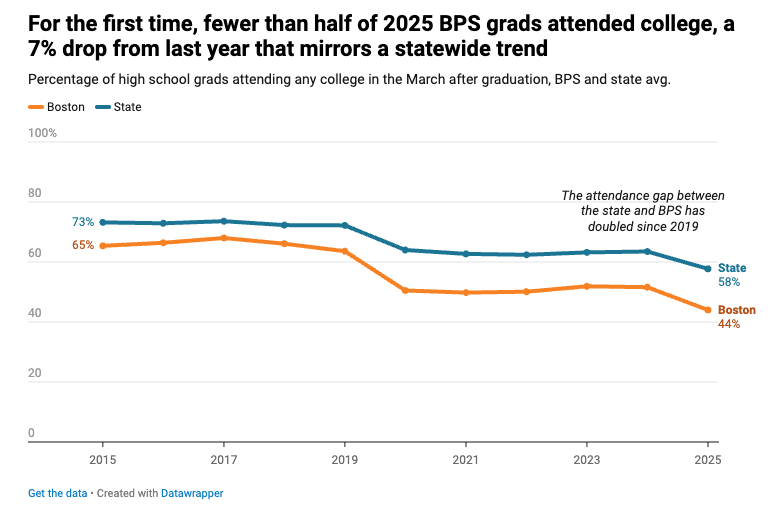
The rate of college attendance for 2025 BPS graduates dropped to 44% from 52% in 2024. College attendance among all high school graduates in Massachusetts also dropped to historic lows, down to 58% from 64% last year. After a similar decline in 2020, college attendance among BPS grads is down more than 20% since 2015. These drops occurred across every demographic and student subgroup.
The dataset, Graduates Attending Institutions of Higher Education, uses data from the National Student Clearinghouse to survey how many high school graduates are actively enrolled in higher education, including private, public, and community colleges. DESE releases two counts for each class, one conducted in the March after their graduation, and one 16 months after graduation. March data goes back to 2015, while the 16-month data is available from 2004. While we will not have 16-month data for some time, we can assume there would be a similar drop in college attendance in that data as well.
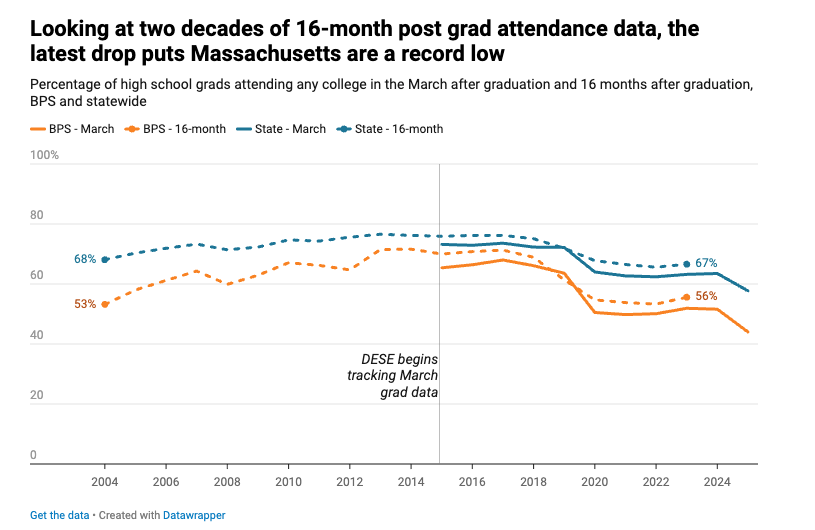
Looking at the 16-month dataset, both BPS and state college attendance rates have moved roughly in tandem. From 2004 to 2014, college attendance rose for both the city and the state steadily. BPS was able to narrow the college attendance gap with the state significantly, rising from 53% in 2004 to 71% in 2014. This compared favorably to the state’s rate of 76% in that year. From 2014 to 2018, attendance rates plateaued. But in 2020, the pandemic upended the equilibrium, and attendance rates for statewide and BPS grads dropped 4% and 8% respectively in a single year. While attendance rates stabilized post-pandemic, the declines had essentially erased two decades of gains in college attendance. With the drop in 2025, it appears that college attendance is now at its lowest levels across Massachusetts in the 21st century.
Despite the fluctuation in college attendance overall, the type of college they enroll in has remained consistent. Over the last decade, roughly 35% have chosen a public 4-year, 40% went private, with the remaining choosing a 2-year public. Of BPS students choosing a 4-year public school, over 80% attend a University of Massachusetts or other Massachusetts college. Much like BPS, 40% of statewide grads also choose a private school. Unlike the state, BPS grads are much less likely to attend a non-Massachusetts public college. While 16% of graduates across Massachusetts attended an out-of-state public college, only 6% of BPS grads did. Attendance at Massachusetts Community Colleges after graduation has declined slightly, from 24% in 2015 to 21% in 2025. This occurred alongside the trend of increasing community college enrollment as a result of free tuition and other incentive programs. However, these programs have largely been targeted at adults over the age of 25, not high school graduates. The MASSGrant Plus program, which now covers costs for many students at all Massachusetts state universities, is likely helping to get Boston students into local public schools.
Demographic Breakdown
The 2025 drop in college attendance occurred across all student subgroups: Asian, Black, ELL, Hispanic, students with disabilities, and White students. All groups have now seen at least a double-digit decline in college attendance rate since 2019. The college attendance rate for BPS grads is now 20% lower in 2026 than in 2019, with the largest declines among Hispanic and ELL students, followed by students with disabilities and Black students. But the most recent decline shouldn’t overshadow the larger trend – the rapidly growing gap in attendance post-pandemic.
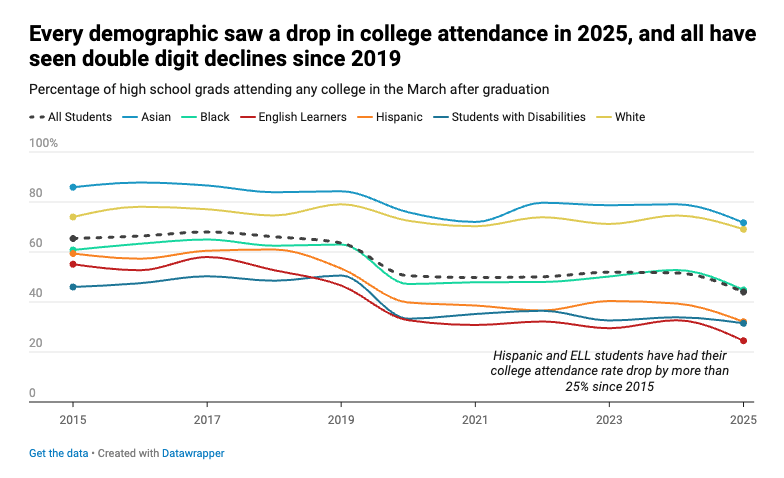
College attendance rates grew from 2004 onwards for all demographics: while just 50% of Black BPS grads attended college in 2004, that number had jumped to 67% in 2014, and students with disabilities saw a 30% increase in college attendance! This was extremely meaningful progress, and BPS succeeded in creating broad postsecondary success. Still, the gap between the groups with most college attendance and the least remained mostly static. But, as we have seen across a multitude of educational metrics, the pandemic was an inflection point. From 2004 to 2019, college attendance among White students was 13% higher than it was for Black Students, and 18% higher than Hispanic students. The gaps from 2020-2023 were 24% and 34% respectively. After more than a decade of rising tides lifting all students, achievement gaps have begun to reopen.
Even as enrollment drops, students still plan on college
In addition to post-graduation data, DESE also collects data on the intentions of high school seniors. It tracks the plans of graduates, including postsecondary education, direct employment, and military service. Statewide, 82% of seniors planned on some form of postsecondary education, 9% said they would be working, and the remaining had other or unknown plans from 2004 to 2019. Over this period, the percentage of students who planned on attending college was 10% higher than the share who were actually enrolled 16 months after graduation. With the enrollment declines after 2020, the gap between plans and college enrollment had grown slightly to 12%. But even with a significant decline in college attendance in the last year, the share of students planning on attending college actually rose slightly, from 75.8% to 76.2%. As a result, the gap between intention and enrollment grew to 18.5%, double the pre-pandemic trend.
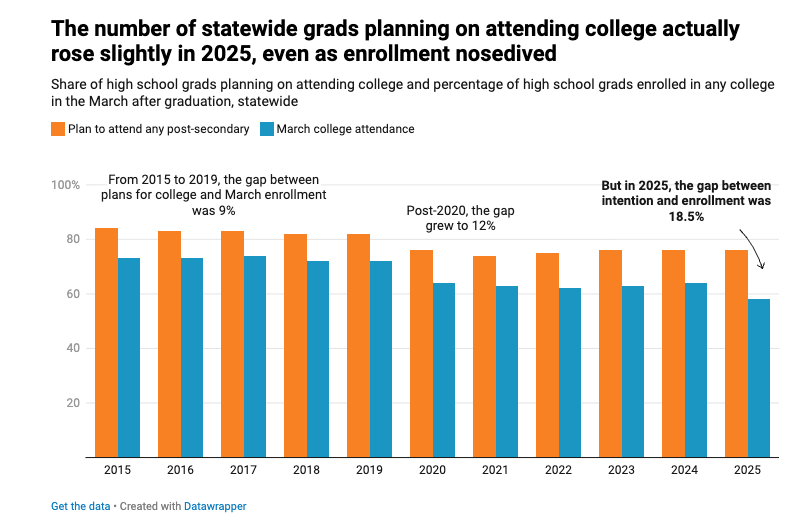
This survey should not be treated as gospel, but it provides a compelling argument against the idea that students see college as unnecessary. An overwhelming amount of students still see college in their future, and even in a year where enrollment cratered, that hasn’t changed. But the share of seniors who plan on working after graduation has increased over the last five years, suggesting that at least some students are forgoing college plans for the workforce. While data does exist for Boston, a much larger share of responses are “unknown” (up to 40%), making over-time comparisons difficult. However, the rate for Boston has been more stable over the last four years, allowing for some inferences. In 2025, 68% of students planned on attending college, a 2% decrease from 2024, and roughly the same as in 2022 (17% were unknown).
All of this suggests that in Boston, as in the rest of the state, high school seniors are still choosing college, but aren’t attending – but why? The answer may be economic. The increasing cost of higher education is no secret, and a look into the economic gap between college attendees is stark. College attendance for low-income high school grads in Boston has dropped from 63% in 2015 to just 38% in 2025. But for students who are not low income, it was unchanged over the last decade at 67%. We see the same trend and the same widening gap at the state level as well.
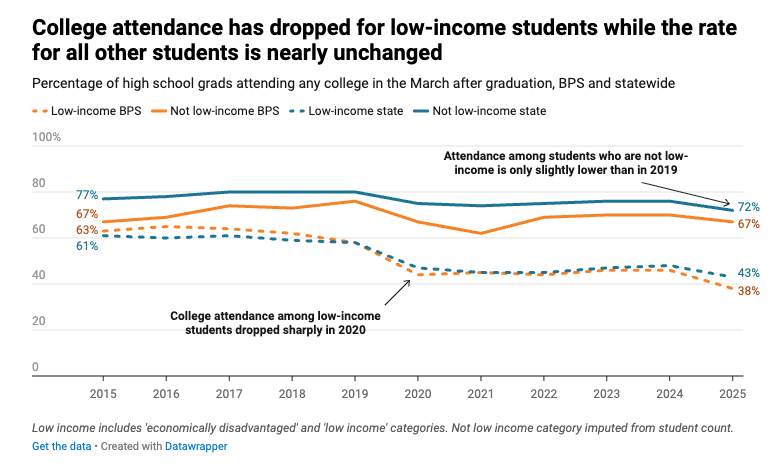
We know that low-income students have experienced disproportionately more learning loss than high-income students, which may contribute to lower college attendance. But we can see the divergence begins prior to 2020, which suggests other contributing factors. Paired with the fact that most students still plan on attending college, this suggests that the direct and opportunity cost of higher education may be behind the decline in attendance.
The question of what exactly high school grads are doing if not college is a hard one to answer. BPS, and the state, have put significant focus on increasing graduation rates over the last few years. As we discussed previously on the podcast, Boston specifically has been graduating students who may have not done so in years past. This might suggest that the new students graduating are less prepared for college. While a possible explanation, Boston’s graduation rate had increased steadily from 2013 to 2021 alongside college enrollment rates. It is possible that graduating more students depresses college attendance, but there’s no clear correlation and it wouldn’t explain the sharp drop in 2025.
The share of students who planned to work after graduation has risen slightly over the last decade to around 10 to 15%. But that clearly understates the actual total given the actual college attendance data. DESE does collect post-graduation wage data, which could give some clues to employment. However, this depends strictly on data from Massachusetts agencies, limiting its reach. Critically, data from the last five years suffers from high non-response and severe methodological issues that make it nearly impossible to rely on. The loss of young people in Massachusetts as a result of high costs of living has been a hot topic of discussion. The growing number of non-college attending high school grads may in part be due to people in the workforce leaving the state. This may also explain the increase in non-response issues in the datasets.
Looking to the future
The 8% year-over-year drop in college attendance for BPS grads is shocking, and worthy of further investigation. The large drop may be a one-off, but the trend of declining college attendance post-2020 is impossible to ignore. To be sure, not every student needs to attend higher education immediately after graduation. But at the same time, the district has made it a point to increase graduation rates and college preparedness, even as reports have called into question how effective these efforts have been. The graduation rate is higher than ever, but the divergence in college attendance, especially among the least resourced students, calls into question if these efforts are enough on their own. Especially as students seemingly still say they want to attend college. But the trend is occurring across Massachusetts, not just in Boston. These issues are impacting students everywhere, it’s unlikely any one thing BPS does will fix it. It calls for a broader response to examine what exact headwinds are facing students and perhaps a reexamination of higher education as it exists today.
Record High, Record Low: BPS Buses Had the Best and Worst Month on Record This Year | Last Night at School Committee: May 6th, 2026
The school committee briefly touched on BPS’s bus transportation performance, continuing to claim ‘great strides’ in addressing structural issues with the troubled system. This was particularly relevant given the need for additional funds to cover overspending on transportation in the current fiscal year. Remember that next year, BPS has budgeted $199M, roughly $50 a day per student transported.
The best of bus times, the worst of bus times
The school committee briefly touched on BPS’s bus transportation performance, continuing to claim ‘great strides’ in addressing structural issues with the troubled system. This was particularly relevant given the need for additional funds to cover overspending on transportation in the current fiscal year. Remember that next year, BPS has budgeted $199M, roughly $50 a day per student transported.
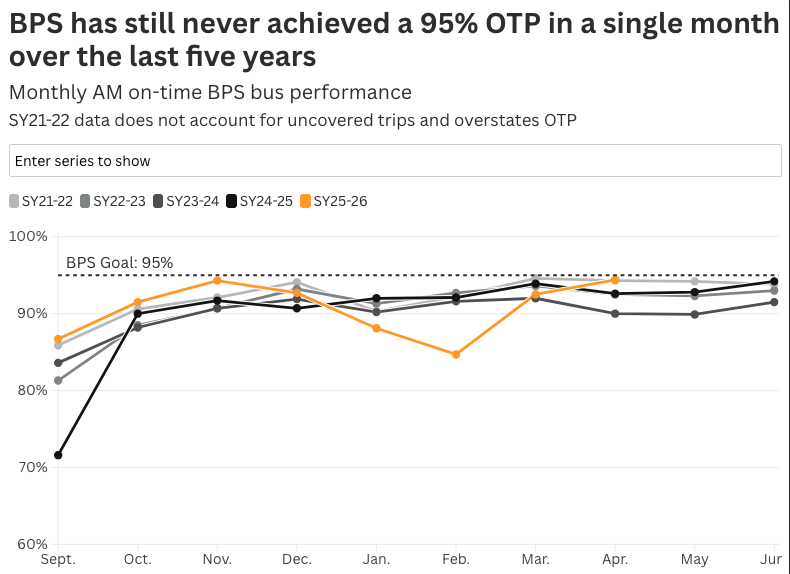
April indeed was the best of times – 94.4% of AM buses arrived on-time, which is the best monthly performance on record. However, this does still fall short of the 95% on-time performance (OTP) goal set by the district and state in 2022. And it was somewhat overshadowed by what could only be called catastrophic bus performance to start the year: January OTP was 88.1% and February was 84.7%, one of the worst months on record. As it did in the February report, BPS blamed snowfall for the deteriorated OTP in the first two months of the year. While the past few years have seen little snow, it’s worth noting that the substantial January 2022 blizzard (23.5 in.) did not appear to impact OTP nearly as much. Regardless, March also saw a lower OTP than years prior despite a lack of snowfall. Year-to-date AM OTP is 90.7%, the highest on record by 0.2%.
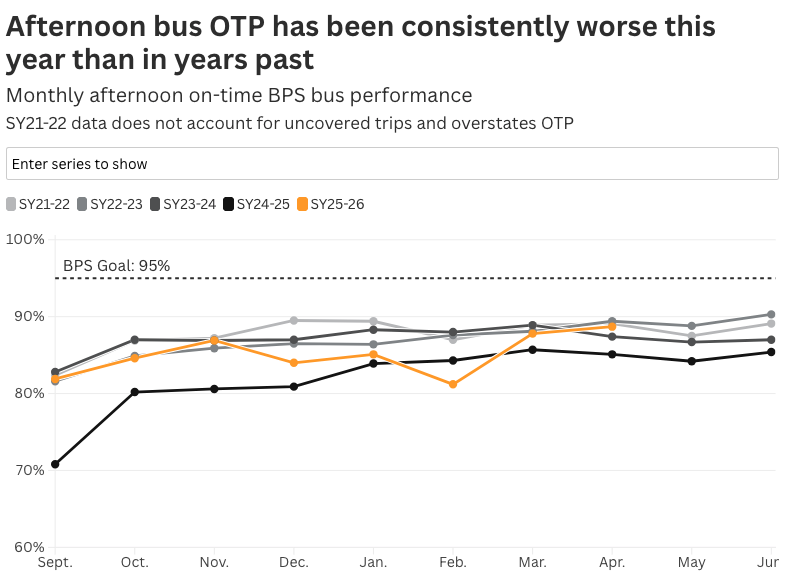
Afternoon data was similarly varied, seeing some of the highest and lowest OTPs on record in April and February respectively. Interestingly, January’s PM OTP was slightly higher than in December, in stark contrast to the snow-impacted AM performance. However, afternoon performance has been worse overall. The year-to-date OTP of 85.1% is lower than both 2022-23 (86.3%) and 2023-24 (87%). This raises serious questions about what structural improvements are actually taking place, and if BPS and Transdev can deliver on their promises.
For the first time in its current contract with Transdev (since 2023), BPS fined the vendor $105,000 for missed trips. Despite being allowed to do this, and Transdev failing its contractual obligation every month since the contract was inked, the district has not exercised that right until now. Although it’s not quite as drastic as it seems: the fine represents around 7% of its $1.6M monthly payment. WBUR also reported that per the contract, BPS could have imposed more than $1,500,000 for all missed trips in the current school year. BPS said in its 2025 transportation report that it runs ~3,000 daily trips, and that in the last three years an average of 0.2% of trips were uncovered. At $500 per missed trip, we can calculate that BPS has forfeited an additional $1,000,000 in fines from 2023-2025. The actual punishment has thus been relatively light, and it remains to be seen if it will result in meaningful improvement.
Putting the budget in context
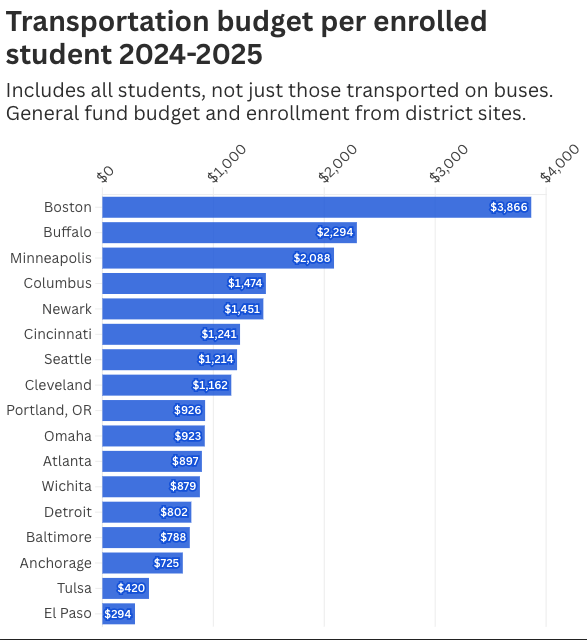
And while BPS’s buses continue to struggle, it is important to remember how much Boston pays. BPS budgeted $178M for transportation, more than 11% of the total operating budget. Looking at comparably sized urban public districts with school bus transportation, only Minneapolis (7.8%) and Columbus (7.1%) come close in terms of budget allocated to transit. On a per student basis (accounting for total enrollment, not just the number of students actually transported), Boston spent $3,866 per student. This was by far the most in the dataset, and more than 70% higher than the next school (Buffalo). Boston pays far more to get far less for transportation.
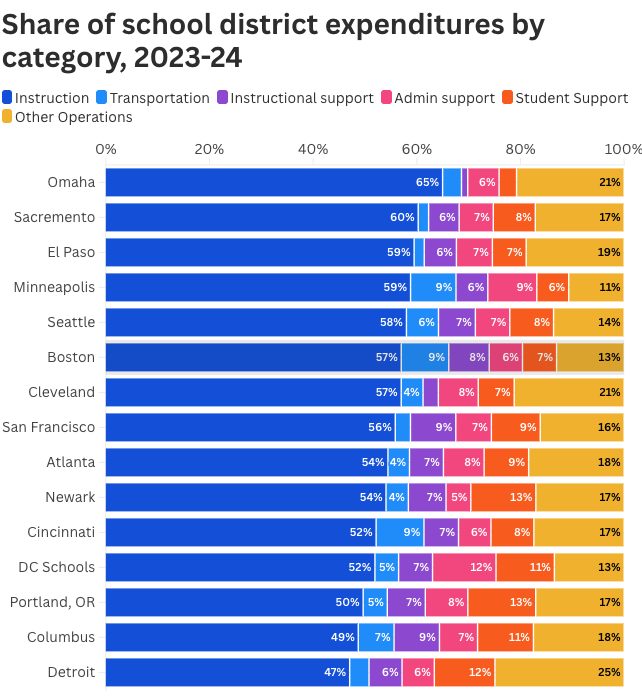
The National Center for Educational Statistics (NCES) has recently released some national data on school finances. While only covering the 2023-24 school year, it provides a comprehensive look at school spending across the country. Looking at comparable urban districts, BPS’s per-student spending stands out at nearly $37,000, more than any other district. Only DC Public Schools at $32,000 per student approaches BPS’s total. Even San Francisco, famed for a high cost of living and public spending, spent only $23,000 for each of its 48,000 students. The data also breaks down spending by rough category. BPS spends an average amount of its budget on instruction (teacher compensation, educational supplies), but significantly more than average on transportation.
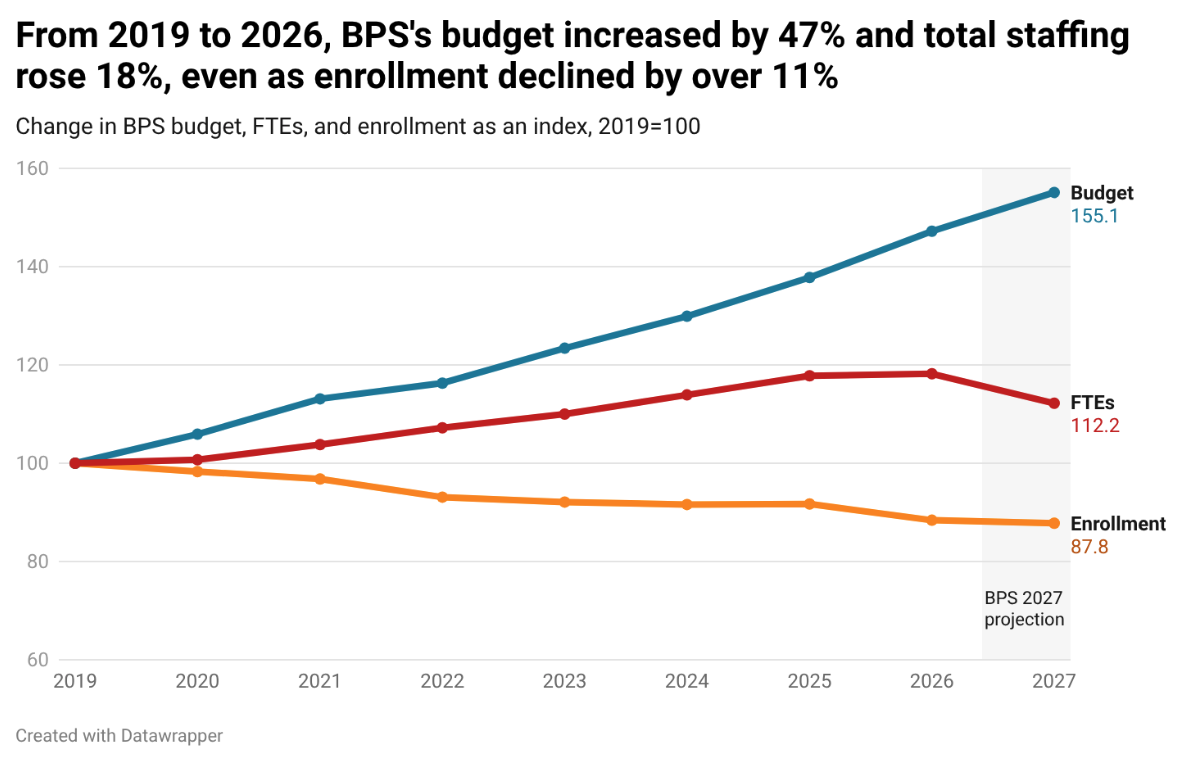
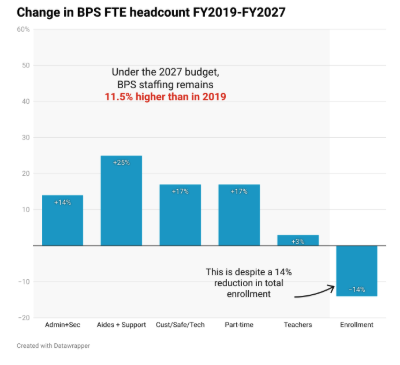
Despite an operational deficit and falling enrollment, BPS’s spending continues to increase mostly unabated. In 2027, the budget will be $1.73 billion, up from $1.1 billion in 2019, a more than 55% increase. Even accounting for inflation, that’s a 20% budget increase at the same time that enrollment fell more than 11%. Staffing has followed a similar trend, with the total number of positions up 12% in 2027 compared to 2019. BPS has cited health insurance costs as a key driver of its budgetary woes but even after cuts, the district still employs more staff than it did in 2024. Even with its reluctance to cut the budget, the current pace of spending paired with historically low enrollment is unsustainable.
A Look at BPS's FY2027-2031 Capital Plan and the District's Facility Quality Gap | Last Night at School Committee: April 15, 2026
Last night’s School Committee meeting touched on a number of critical issues for BPS, including a vote on a policy amendment to MassCore, an ask for more money to fill a budget gap, an update on decade old policy surrounding opportunity and achievement gaps, a new strategic roadmap, as well as an an approval for a new MSBA statement of interest. To learn more about these topics, please listen to the podcast for more in-depth analysis. Regarding BPS facilities, which played a key role at the start of last night’s meeting, we conducted an analysis to better understand the future of the district’s capital plan in the coming years.
Last night’s School Committee meeting touched on a number of critical issues for BPS, including a vote on a policy amendment to MassCore, an ask for more money to fill a budget gap, an update on decade old policy surrounding opportunity and achievement gaps, a new strategic roadmap, as well as an an approval for a new MSBA statement of interest. To learn more about these topics, please listen to the podcast for more in-depth analysis. Regarding BPS facilities, which played a key role at the start of last night’s meeting, we conducted an analysis to better understand the future of the district’s capital plan in the coming years. Read more, below:
FY2027-2031 Capital Plan
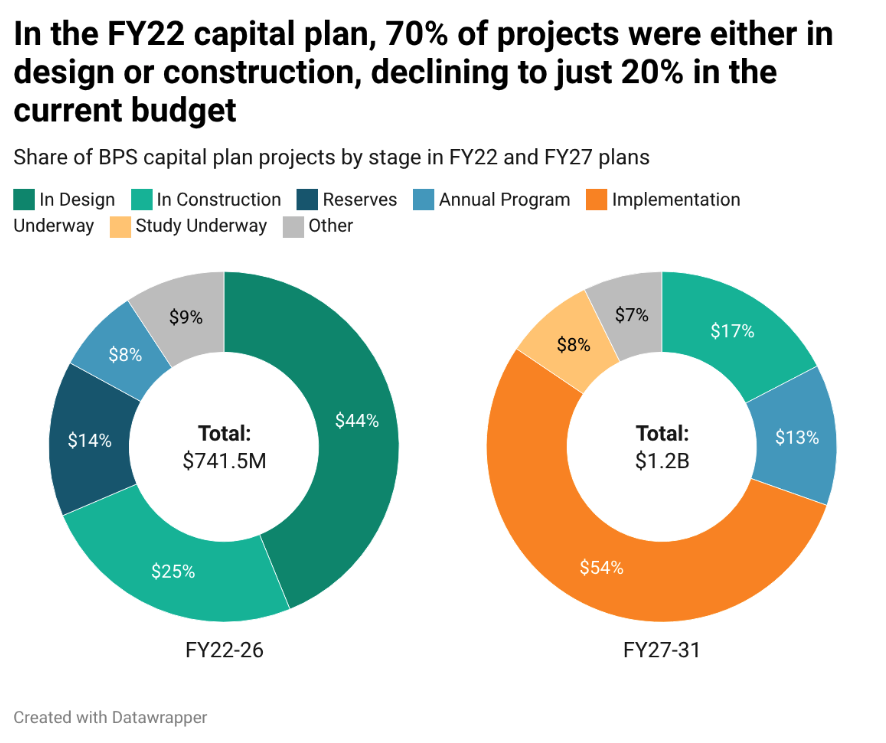
Last week, the City of Boston released its FY2027-2031 capital plan, outlining the $4.4B in projects it will undertake over the next few years. BPS’s share of the capital budget is $1.23B or 28%, the highest proportion it has received since at least the FY2022 plan. Since that year, BPS’s capital plan has grown from $741M to over a billion thanks to additional city investment on the heels of Mayor Wu’s 2022 “Green New Deal for Schools” promise to invest billions in improving the district’s buildings, aspiring to have ‘fully redone every school building’ by 2032. While spending has increased and the district has opened a number of new or fully renovated schools, the cost and time needed bring into question the feasibility of this goal.
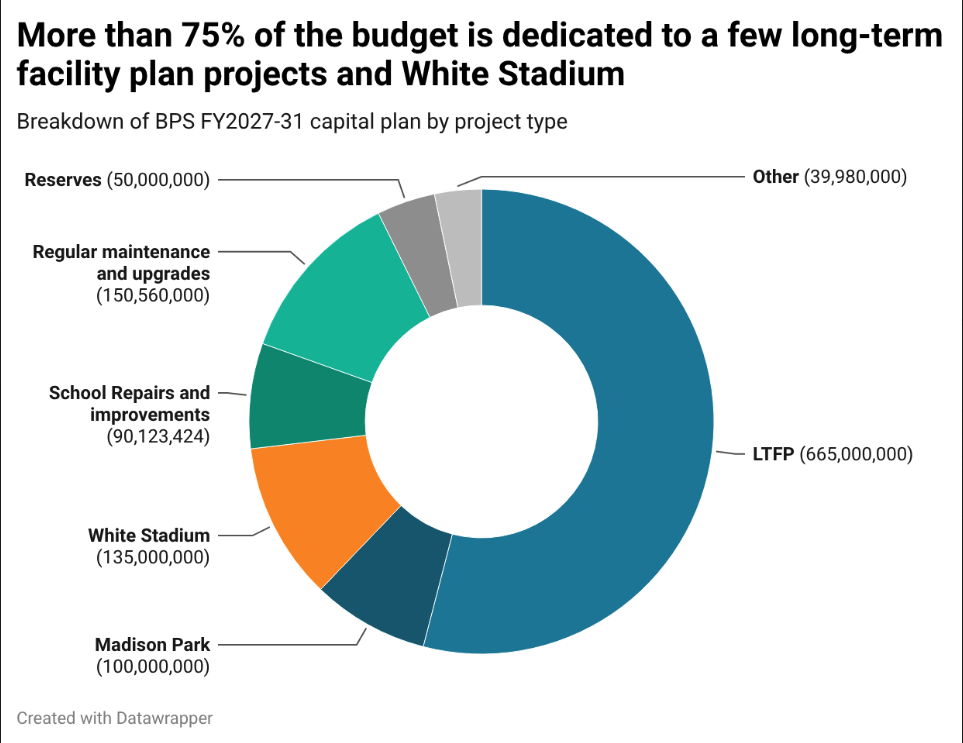
In the latest 2027-2031 capital budget, 65% of the spending is dedicated to major school renovations or building new schools through the Long-Term Facilities Plan (LTFP) and additional funding from the Massachusetts School Building Authority (MSBA). However, only three school projects (Madison Park, Shaw-Taylor, and Ruth Batson) are currently slated to move forward with the current $900M+ in budgeted spending. That cost is likely to rise given Madison Park’s predicted $700M+ pricetag, as it is currently budgeted for just $100M, although some of the $665M budgeted for LTFP will be used for it. While the final capacity of the Ruth Batson is not known, the other two projects (currently slated to finish in the 2030s) have a total capacity of 3,000 students. Along with White Stadium, for which the city’s share has nearly tripled to $135M over the last few years, these projects make up 76% of the capital budget, leaving little room for fiscal flexibility or other major projects.
Since Mayor Wu took office, three new schools have been completed, all of which began under her predecessor. Those were the Boston Arts Academy, Carter School, and Josiah Quincy Upper School, which together have capacity for 1,200 students. Built with the help of MSBA funding, BPS allocated $470,000,000 in capital funding, coming out to over $390,000 per new seat created. Each of these projects were the most expensive MSBA projects in state history per square foot at the time they went to bid. The Boston Arts Academy cost 33% more than the state average in 2021. Quincy Upper was set to cost $1,000 per sq. ft., 53% higher than the state average 2022. At these costs, it becomes increasingly difficult to see how BPS will be able to afford any new projects, especially since municipalities are limited in the number of MSBA projects in the pipeline at any one time. With BPS’s three current MSBA core projects (and a potential fourth with the Mel King, announced at the Committee meeting), it is unlikely that the district will be able to secure more major funding until those projects are completed. When unable to secure MSBA funding, the district often drops renovation plans, as was done with Otis and Blackstone, or the Community Academy of Science and Health, which later closed. The district has completed just two self-funding major renovations for the Horace Mann and Philbrick-Sumner merger, totaling $137M for 1,100 in new capacity ($125,000 per student seat).
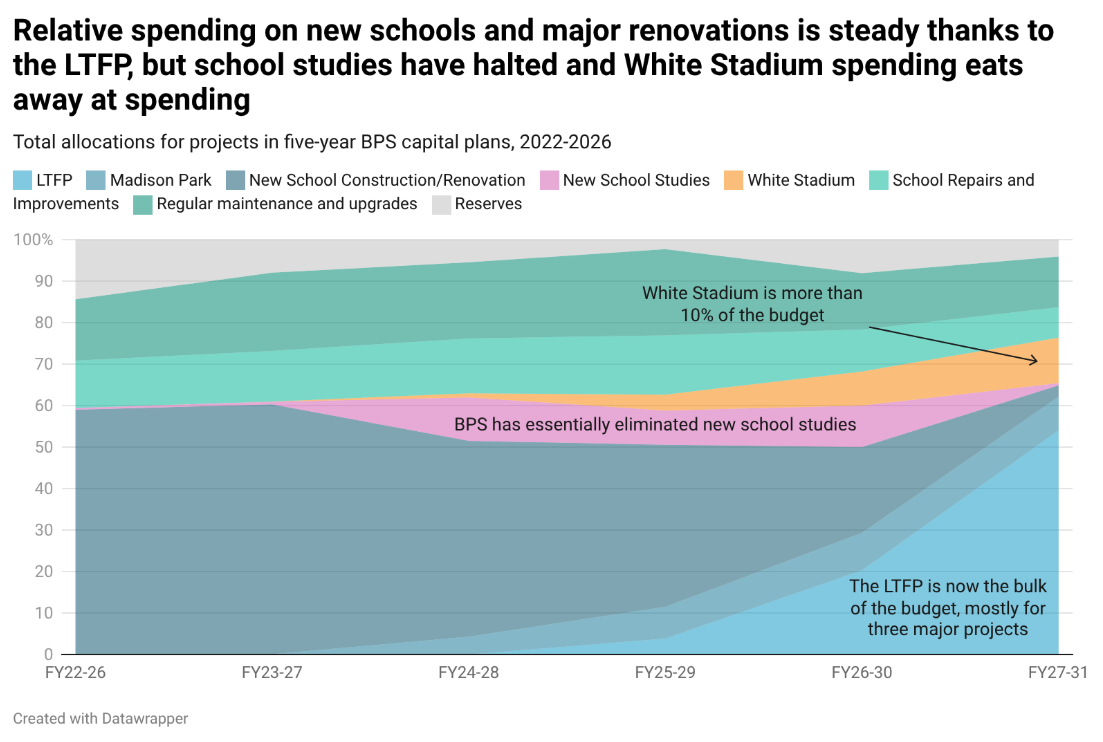
The pace of projects has also slowed dramatically. The capital budget categorizes projects by their status: ‘annual program’ and ‘reserve’ represent ongoing commitments (regular maintenance, replacement) or funds held for future projects. ‘Study’, ‘in design’, and ‘in construction’ represent the progress of major projects. In 2022, more than 70% of funds were allocated to projects in design or construction – including the Carter, Quincy, and Arts Academy. However, that total has dropped to just 20% of the new budget, most of which is for White Stadium. Instead, projects are overwhelmingly studies (a pre-planning phase), or ‘implementation underway’. The latter category is largely for ‘Improvements at several school buildings as part of implementation of the Long Term Facilities Plan, as well as a strategic reserve for MSBA Core projects,’ which the budget does not break down further. However these funds are likely overwhelmingly reserved for the three major school projects once they begin, as well as some funds for smaller renovations. But either way you cut it, by dollar spent or total projects, BPS is actively building less than it has in years while spending more than ever. Given the enormous number of students still in schools with ‘low quality student experiences’ and the near expiration of the current Long-Term Facilities Plan, there are serious questions as to how the district will move forward.
BPS Facility Quality and Planning
The district released the Long-Term Facilities Plan in 2024 in order to address the district’s physical footprint and to achieve what BPS calls a ‘High-Quality Student Experience". This plan involves expanding the district’s footprint with new schools and major renovations, and merging and closing some lower quality schools. The district has seen mixed results at a high cost for the former, but more success with the latter as it has closed a dozen schools over the past several years. Despite this, nearly half of all students still attend schools that the district says provide an inadequate learning experience.
As a part of the LTFP, the district assigns each school building a ‘Building Experience Score’ from 0 to 4, which rates a number of physical, educational, support, and community metrics to evaluate if it is a high-quality experience. Schools with scores 0-2 are inadequate and BPS aims to either improve or close them. This is much complicated by the geographic spread and grade level of each school, and ongoing enrollment struggles. As it currently stands, BPS has capacity for 52,000 students against a current enrollment of 46,000. This is not evenly distributed, some schools are vastly overenrolled (Sarah Greenwood K-8 is at 168% of its capacity) or underenrolled (Condon K-8 is less than 50% capacity). But of these 52,000 seats, just 53% are in schools rated a 3 or 4. The district currently only has 27,600 quality seats for 46,000 students – over 48% of children still attend schools the district calls low-quality!
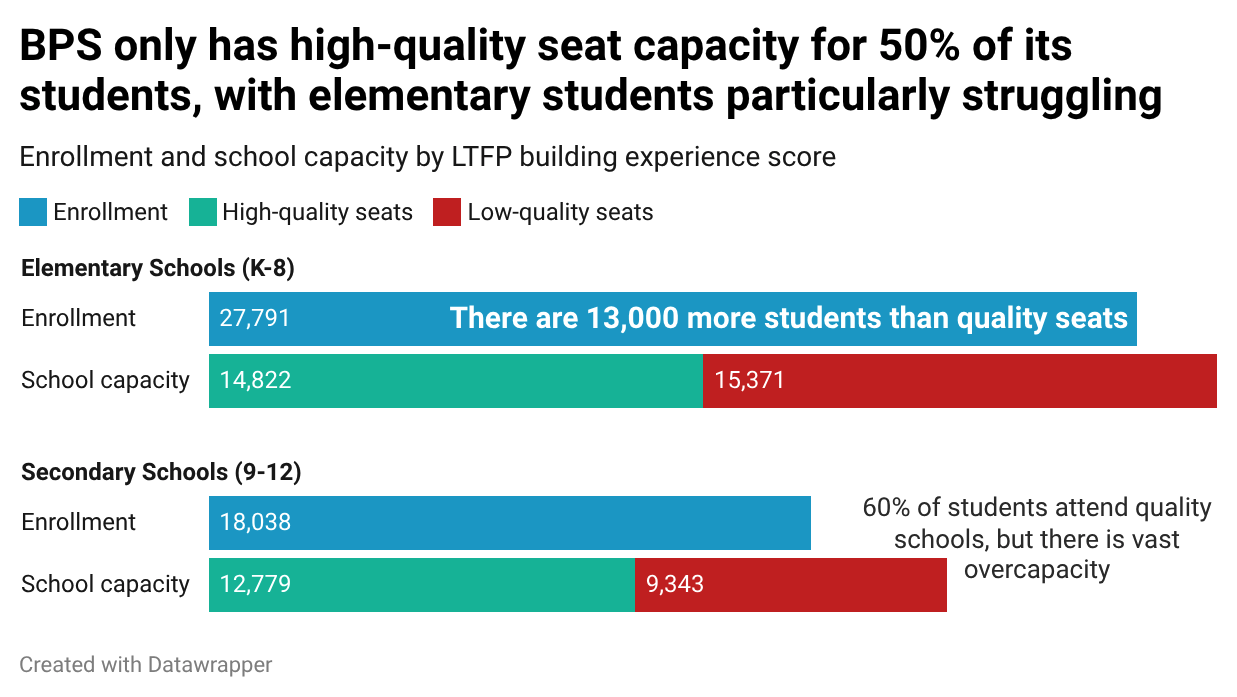
This is an enormous gap to close. The new schools and major renovations over the last five years only created 2,300 seats. The three new projects, years from completion, may double this, but tens of thousands of students will still be unable to access high-quality school seats. The long-term facilities plan currently ends in 2029, with a few more school closures planned but no other major renovations. Amid ongoing budget crunches with the city and BPS, who has requested another $23M in operating budget, it is crucial for the district to outline how it plans to bring all its facilities up to par. BPS needs to present a new facilities plan, one that addresses all schools and all students, and that sets realistic and achievable goals for the near future.
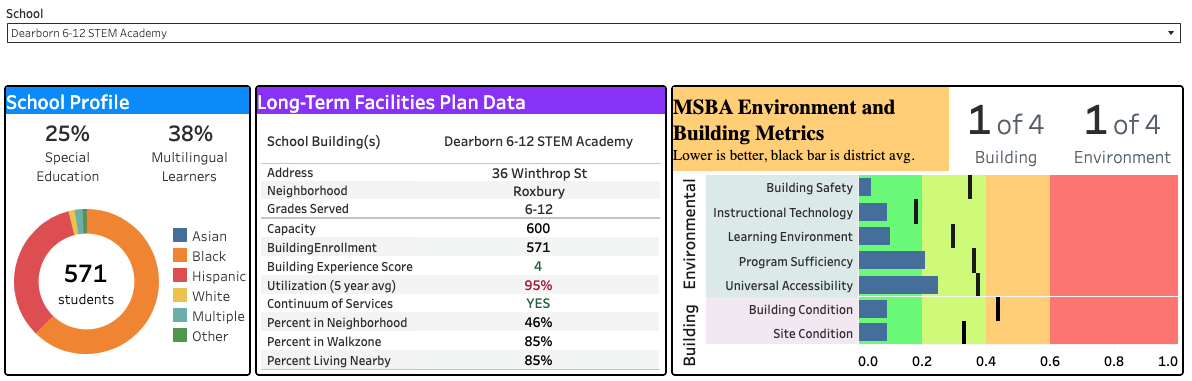
To help better understand the struggles that BPS facilities are facing, we are working on a new tool to go along with our existing budget tool. It will allow users to view each school and key information about its condition, uniting data from BPS the MSBA, highlighting schools at risk of closure based on the district’s own metrics, and other key achievement and management trends. See below for a teaser:
FY2027 Budget Adopted, MassCore Completion Rates Questioned, and School Choice Discussion Revisited | Last Night at School Committee: March 25, 2026
Last night was the first full meeting in a month after a series of budget hearings. The meeting covered three topics; vote on the 2026-2027 budget, update on MassCore and the annual discussion on school choice. We dig into each of these areas below and on the podcast. We are also excited to unveil a new tool to help you better understand the BPS budget.
Last Night at School Committee - March 25, 2026
Last night was the first full meeting in a month after a series of budget hearings. The meeting covered three topics; vote on the 2026-2027 budget, update on MassCore and the annual discussion on school choice. We dig into each of these areas below and on the podcast. We are also excited to unveil a new tool to help you better understand the BPS budget.
The FY 27 Budget Vote
We have spent a lot of time covering Boston Public School’s budgetary challenges. With the adoption of a $1.71B budget, a 4.5% increase from last year after already running a deficit this year, it is more important than ever to understand where this money goes. We are proud to introduce our FY2027 BPS School Budget Viewer, an interactive tool that combines years of complicated data and presents it in an easy-to-understand format for public use. Click the link above, or go to the Last Night at School Committee Page on the Shah Foundation site to access it.
The tool has multiple dashboards that lets students, teachers, policymakers, and concerned citizens understand how the budget is changing in 2027 and how we got there. School Database allows you to explore enrollment, budget, and staffing changes for individual schools from 2026 to 2027. The dashboard shows district-wide changes, and searching for or clicking on individual schools in the list will bring up school-specific data. Budget Breakdown details how the FY2027 budget is spread between direct school funding and central office funding, and how each broad category and specific line item is changing. Hovering over each box provides more information, and filters on the right allow for a closer view. Budget Over Time will detail how each broad budget category has changed since 2019, and which portions of the budget have grown the fastest.
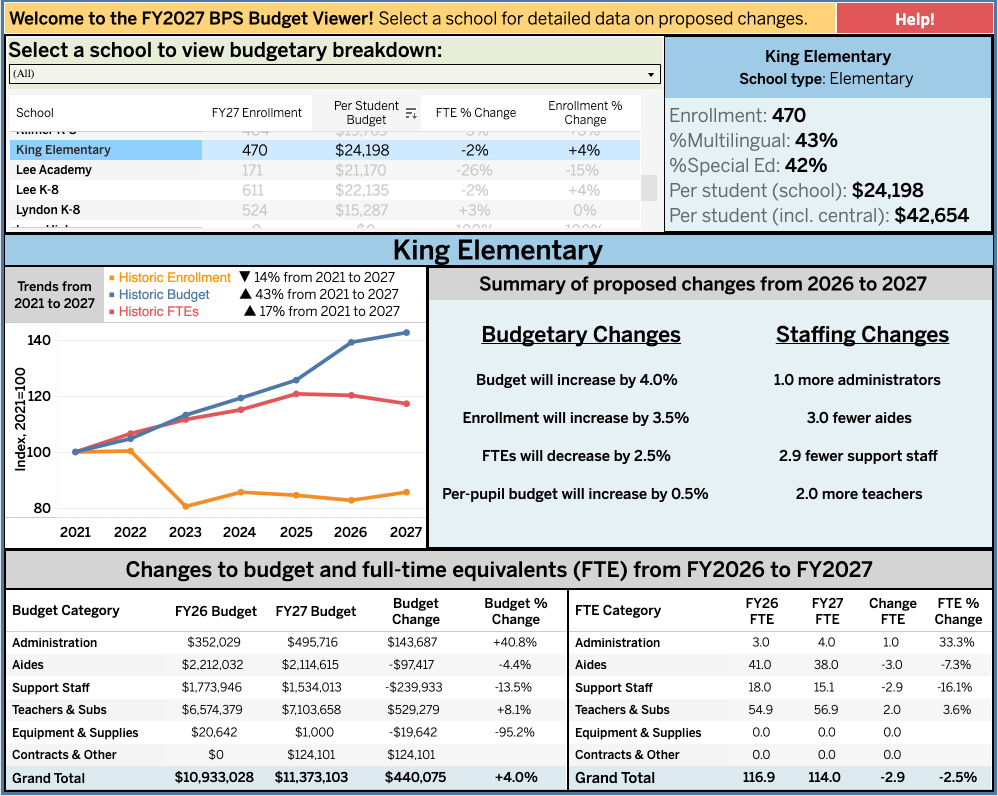
The tool allows you to explore school-level changes and easily see the individual changes coming in the next year. In the screenshot above, we can see that King Elementary is predicted to see a 3.5% increase in enrollment over the next year, and a corresponding 4% increase in budget. However, it will see a decrease in staffing, including the elimination of 6 aides and support staff alongside 2 more teachers and 1 more administrator. The chart on the left of the interface shows how the school has changed over time. In this case, King Elementary has seen a 14% reduction in enrollment since 2021 – but a greater than 40% increase in total budget.
But school budgets are only half of the BPS budget, and centrally budgeted functions make up over 50% of the $1.71B total. Looking at those charts allows us to see the serious structural problems leading to BPS’s budgetary woes. We have covered the central budget, and specifically transportation (which will cost $45 per student transported per day) in the past. But this tool allows us to put into perspective how much transportation and ‘business services’ (largely employee benefits) alone cost the district. It’s important to understand the budget crunch does not come from one line item or one unexpected expense. It is true that health insurance costs were higher than expected this year. But this is largely a function of hiring more staff than the district could handle, a choice entirely within BPS’s control. The painful 400+ FTE reduction this year is large, but BPS will still have 10,469 staff, more than it did in 2023, even though enrollment is far lower. Transportation had an ‘unexpected’ cost increase, but it’s grown by 68% since 2019, even with far fewer students transported. These are not surprise costs, they are the result of specific choices and years unaddressed rising costs. The district promised in its 2022 Long Term Facilities Plan (now reaching the end of its proposed changes) that there would be significant cost savings from right-sizing the district. In 2021, there were 121 buildings and the district spent $53/m on facilities management. In 2026, there were 109 buildings and the district spent $68M on facilities management, not counting the 120% increase in planning and engineering costs since then. Promised cost savings have not been delivered.
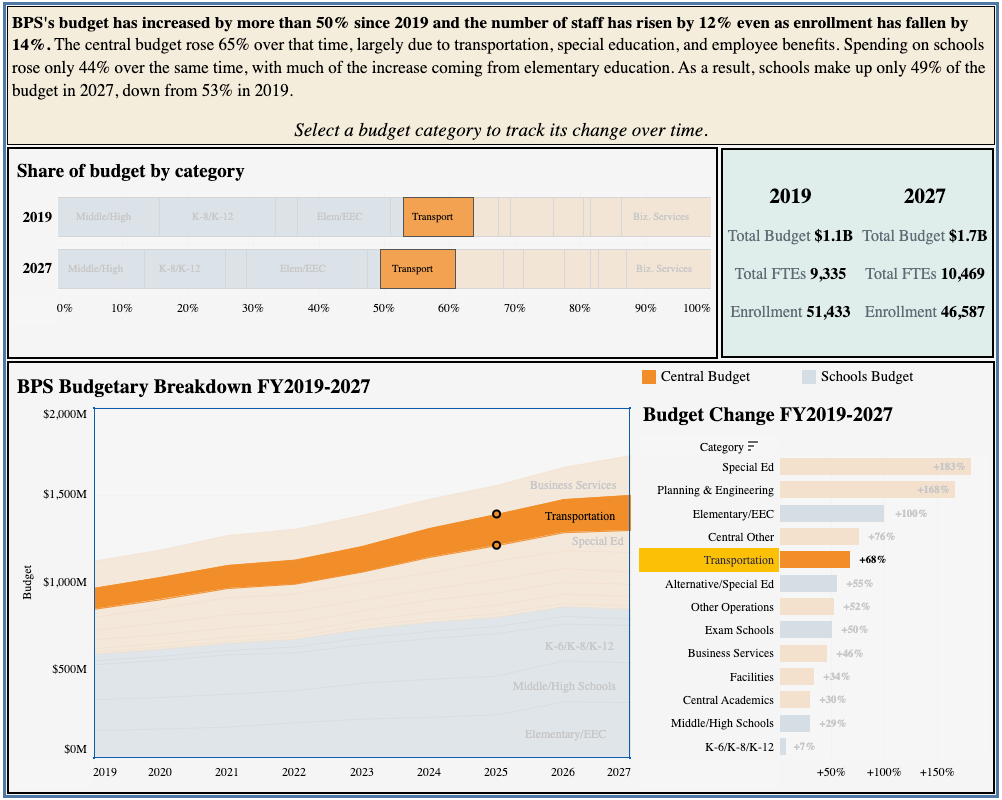
In 2027, BPS will spend over $36,820 per student, up from $20,373 in 2019. Across the board, BPS spends more to educate fewer students every year. While some of these increases are certainly worthwhile, the current trajectory is not sustainable. There is no ‘silver bullet’ to bring costs down, and no single outsized cost or program is to blame. A deep, honest, look at how and why BPS spends what it does is critical for the continued function and success of the district and its students. We hope that this budget tool can help contribute to this necessary conversation.
MassCore: What Does Progress Mean?
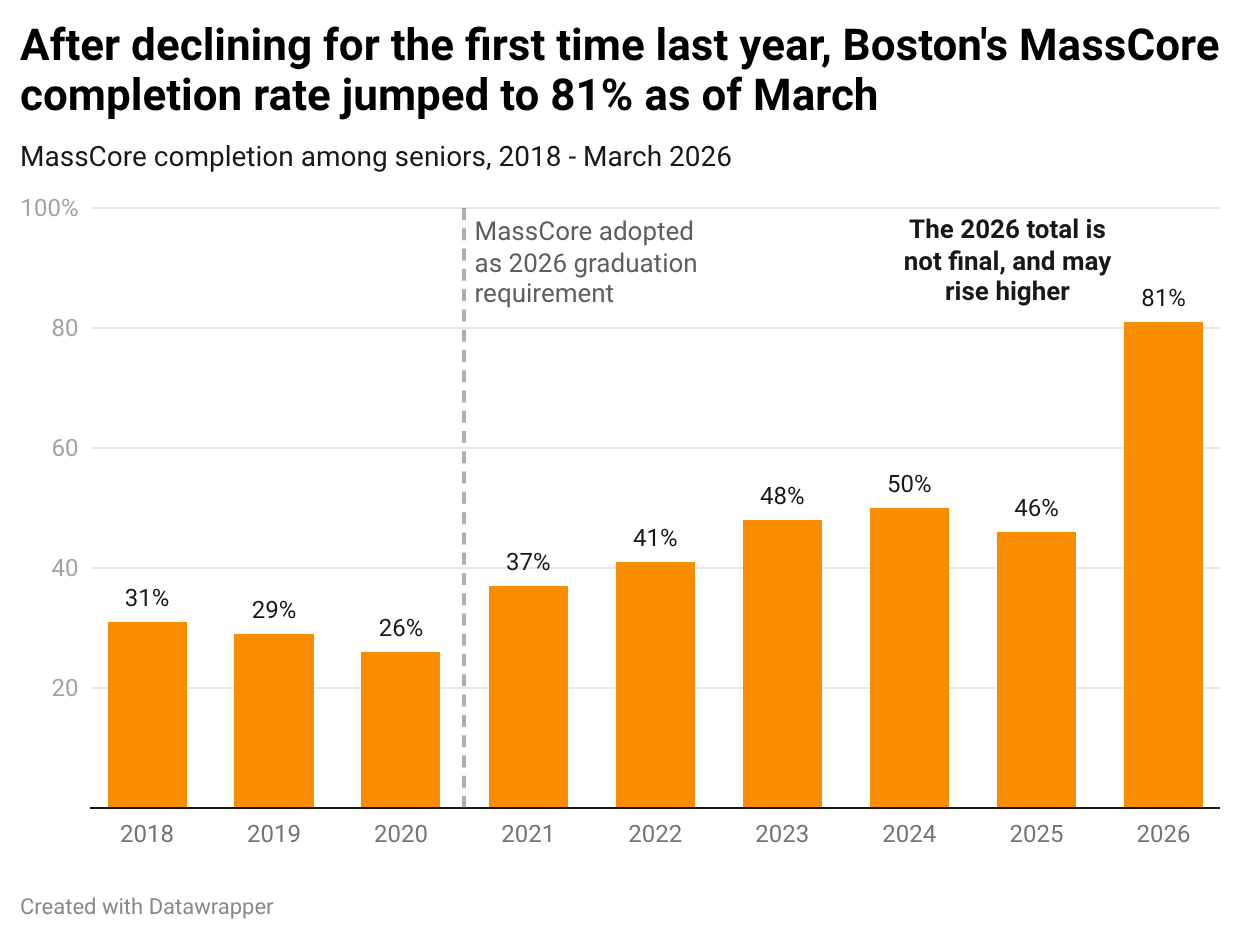
One of the meeting’s most revealing discussions came during the update on MassCore graduation requirements. District leadership reported that 81% of the Class of 2026 is now on track to meet MassCore requirements which represents a dramatic increase in a relatively short period of time. This improvement was attributed to ongoing support, credit recovery, and expanded pathways. But the speed of that progress raised questions. If the district struggled for years to move this number, how did it suddenly improve so quickly? Vice Chair Skerritt introduced another layer to the conversation: MassCore compliance is, to some extent, self-reported. Districts determine how courses align to requirements, meaning that similar outcomes across districts may not reflect the same level of rigor.
As we have covered previously, Boston has struggled to have its seniors meet the MassCore standard. In 2021, the district adopted it as a future graduation standard for the class of 2026. At the time, just 31% of seniors fulfilled the MassCore requirements. As of 2025, only 46% of students completed MassCore. After years of minimal progress, it was thus when BPS announced last night that 81% of seniors have now completed MassCore. This near doubling of MassCore completion taking place seemingly overnight is hard to square with the district’s previously languid pace. This chart shows the stunning reversal and 35% year-over-year increase that followed a decline from 2024 to 2025.
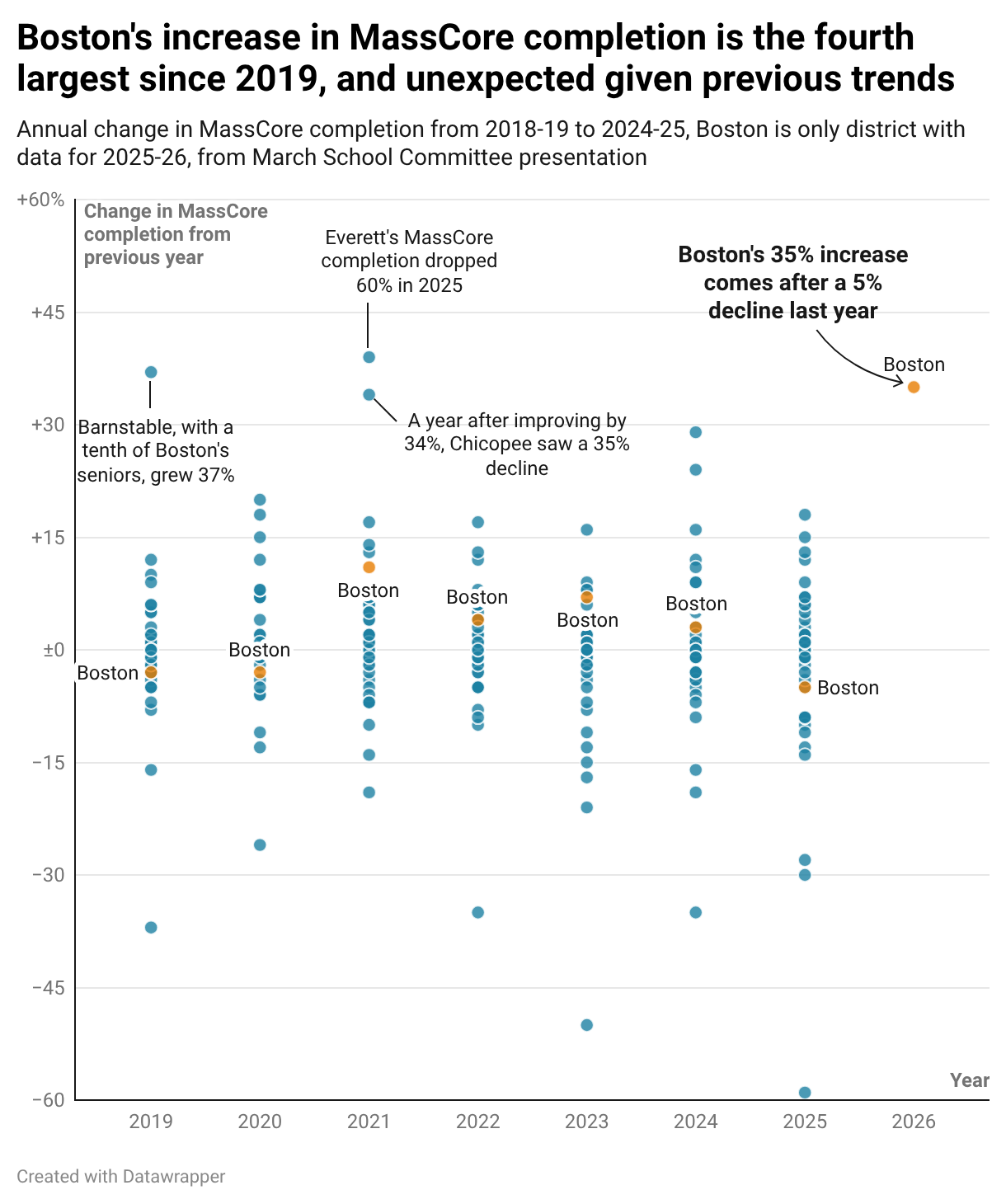
Since adopting MassCore as a standard, the district averaged just 2% growth, far slower than most other large districts. The next chart details the yearly change in MassCore completion for more than 60 large public school districts in Massachusetts since the standard was overhauled in 2018. If it holds, Boston’s annual increase would be the fourth largest ever, and one of just a handful of extreme outliers. Districts with similar single-year overperformances have not all succeeded. The largest increase came from Everett, which saw a 39% increase from 2020 to 2021. While it retained 100% completion for years after, the district saw completion plummet to 41% in the last year, the largest drop on record. Chicopee increased by 34% one year, only to decline by 35% in the next. Barnstable, with just 350 seniors, was the only district with such a large increase to retain its improvements.
This increase raises many questions. If the district could rapidly bring students up to the MassCore standard, why did they not do so in the years following the 2021 vote? If the district truly believes that completing the MassCore curriculum best equips students to succeed, then what does that say about the students who graduated without it? If the district was unable to get students up to the standard until the last six months, what changed? Expansion of Early College and Vocational Pathways and separate credit requirements for alternative schools are too limited to have such a large impact on district-wide completion rates. The single biggest challenge that the district identified with increasing MassCore completion was the 6 period bell schedule. While they adopted changes to move to a 7 period schedule, those only made possible by changes to collective bargaining agreements and do not take effect until the next school year. If they have managed to achieve 80% completion without those schedule changes, were they necessary?
Two possible explanations lie with ‘Student Circumstances’ and ‘Credit Recovery’. The former largely deals with students who transfer into the district and how their previous educational experience is counted towards BPS credit completion. The district wide latitude in determining how previous credits count and acceptable alternatives without formally filing a waiver. The latter is a program that lets students take online courses for credits they have failed or otherwise missed. School leaders have cited credit recovery programs as a key tool to help graduate students. In 2012, the district identified nearly 400 students who would have otherwise been ineligible for graduation using credit recovery to graduate, helping to increase the district-wide graduation rate by 4.8%.
School Choice: Is a Pilot Worth It?
The final major topic of the evening was the Massachusetts Interdistrict School Choice Program, which requires districts to either opt in or formally withdraw each year. Despite ongoing enrollment declines, BPS has lost roughly 10,000 students over the past decade, the conversation around school choice was relatively subdued. This is despite the fact that over the past three years, committee members have hypothesized about potential pilots that the district could try to increase the student body across the district. District representatives noted that members of their team were looking at potential options and consulting with the legal department to understand what would be compliant. Nevertheless, no major shift in strategy occurred last evening, and it seems like the district will opt-out once again.
What’s Next?
The next Boston School Committee meeting will be held on April 15th at 6:00pm. Stay tuned for more from the Shah Foundation team in the meantime! Be well, and go Sox!
The Boston Globe’s Christopher Huffaker on BPS’ Graduation Requirements | Last Night at School Committee: Special Episode
Earlier this month, we recorded a special conversation with Boston Globe reporter Christopher Huffaker. Huffaker is a reporter for “The Great Divide” - an investigative arm of the paper that analyzes and reports on educational inequities throughout the state.
Last Night at School Committee - MassCore
Earlier this month, we recorded a special conversation with Boston Globe reporter Christopher Huffaker. Huffaker is a reporter for “The Great Divide” - an investigative arm of the paper that analyzes and reports on educational inequities throughout the state.
Huffaker spoke to our team about a prominent issue we have covered at length on Last Night at School Committee: MassCore. The interview began with a conversation about AP scores around the Commonwealth, and whether the results indicate true success for the state. From there, Ross asked Huffaker to talk a bit more about his recent report that almost one-third of BPS seniors risk not graduating high school in June. In his analysis, Huffaker noted that MassCore, put forth by the state, is a logical benchmark for students to meet, as it aligns with requirements for entry to the Massachusetts college system. He also flagged that this new system was really a situation that raised the standard for many students. As a result, while some students reached a new level of academic achievement, others were left without an opportunity to graduate.
Throughout the conversation, Ross and Huffaker touch on whether the district will vote to amend MassCore as a graduation standard at a future meeting, what “exemptions” may look like for students, and ways to ensure all students meet the completion of MassCore requirements.
Just yesterday, the district released data highlighting that graduation rates reached an all time high last year. We will be on the lookout for how MassCore requirements impact this rate.
Stay tuned for more from the Shah Foundation team later this month.
Central Office Budget Recap | Last Night at School Committee: March 4, 2026
Last night, the district had a two-part meeting, beginning with a Budget Hearing for FY 2027 and then a short School Committee meeting. The budget hearing largely touched on many of the same financial themes we have heard from the district before, including transportation costs and collective bargaining expenses, while also highlighting some more granular fiscal challenges at the school level. School Committee members asked a number of questions about multilingual programming, cuts to personnel, and the connection between the FY 27 budget and the long-term facilities plan.
Last Night at School Committee - March 4, 2026:
On Wednesday evening, the district held a hearing focused on the Central Office budget. In their presentation, district leadership stated that they prioritized "student-facing" investments that directly supported schools. Highlights from the central office budget include an $86 million increase due to four main categories: health insurance, transportation expenses, special education, and collective bargaining. More specifically, transportation saw a year-over-year rise of 9%, and special education saw a significant jump of 22%. The district was able to find some operational efficiencies in the budget. For instance, they were able to reduce the number of staff at the central office, thus saving $11 million for FY 27. Nevertheless, there are significant financial outlays in the district’s budget that hamper the impact of these minimal savings.
During the public comment period of the hearing, there were 38 public speakers, many of whom were concerned about the impact of staffing cuts on student life and experience. School committee members then pushed the district to respond to questions about cuts to paraprofessional staffing levels, the enormous cost of transportation, and how student outcomes align with the budget. The budget process will continue with a final hearing on March 18, followed by a School Committee vote on March 25, before heading to the Boston City Council for final appropriation.
Check out our analysis of the BPS Central Budget below:
Central Budget Overview:
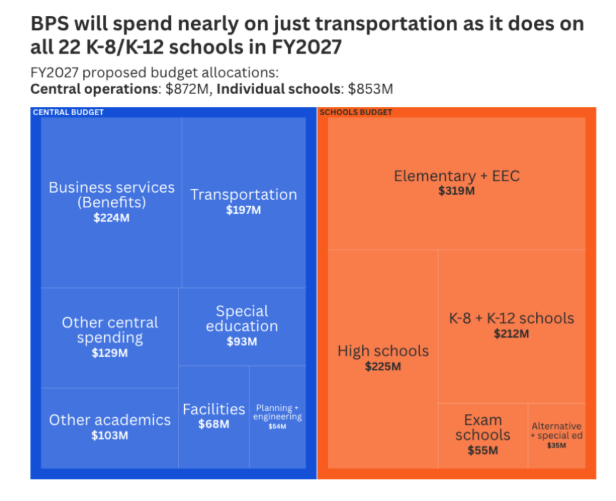
The proposed FY2027 budget for Boston Public Schools is $1.71B, a 4.5% increase from current spending levels, and 8% higher than the budget passed in 2026. The BPS budget is divided between ‘Central’ and ‘School’ spending, with the former representing district operations and centrally-budget services like transportation or special education, and the latter representing individual school budgets and teacher salaries. Much of the central budget does represent funds that go to students in schools, which the district refers to as ‘Centrally Funded Directed to Schools.’ While worth keeping in mind, this distinction can complicate comparisons, and in this document, central spending will refer to spending under ‘Departmental Detail’ in BPS budget tables such as this unless otherwise noted. (1) Central spending represents a significant and growing slice of the total budget. BPS plans to spend $873M on central operations, a 10% increase from current spending levels, and $853M on schools, a 1% decrease from current spending levels. For the first time, the total central budget will eclipse total school spending. Much of this increase comes from a 23% rise in budgeting for ‘Business Services’, which represents mostly employee benefits. Benefits specifically(2) are rising by $40M, driven by a $34M increase to health insurance costs. The district has pointed to employee benefits as the largest driver of the deficit and persistent budgetary woes, which have impacted municipalities and districts across the United States. In large part, this is driven by excess hiring and the district choosing to significantly increase FTEs over the last five years even in the face of declining enrollment. But while benefits represent a large portion of the increase for the coming fiscal year, they do not explain a majority of the growth in central spending.
 (1)Totals for FY27 represent proposed and not final decisions, but proposed budgets have historically been very representative of final budgets.
(2)  Found here, or in the account category of the budget tables.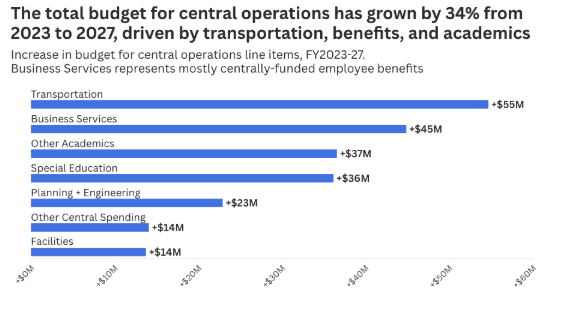
Central spending has grown by $223M (34%) from the FY2023 budget to the current budget proposal. But spending on business services only accounts for $44M or a fifth of that growth over the last five years. In fact, spending on transportation increased by $55M over that period – more than benefits! Benefits also do not make up a particularly high proportion of central spending, even in 2027. Business services comprises 26% of all central spending in FY2027, which is still lower than in 2023 when it made up 28% of spending! Even pre-pandemic, business services represented over 29% of central spending in FY2019, far more than they will in the coming year. Even if spending on benefits held steady, BPS would likely still be facing significant budgetary headwinds. The District's budget problems cannot be ascribed solely to ‘unpredictable’ health insurance cost increases; the deficit must be discussed in the context of years of broad budget growth.
Transportation, in particular, is a concerning budget item as it is the second largest expenditure for the central budget behind benefits and is one of the few budgetary items to see an increase even in a deficit year. At a predicted $198M for FY2027, it represents among the largest slices of the budgetary pie. BPS plans to spend nearly as much on bus transportation for 22,000 students (3) as it will on K-8 schools, high schools or centrally budgeted academic programs like special education and early childhood. Here again, the district has offered a number of explanations for the cost increases, but an examination of the data shows that it is not simple.
(3) Rough estimate per the 2022-25 Transportation Progress Report. Despite Public Records requests, BPS asserts it does not store the data necessary to report current ridership totals.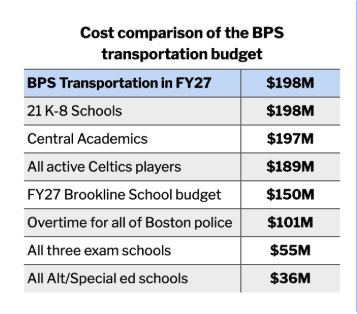
Transportation Budget Overview:
In 2022, Boston agreed to a Systemic Improvement Plan with the state and DESE which covered all aspects of BPS’s operations, including transport. At the time, the city and district agreed “to undertake the initiatives outlined below and to be held accountable for reaching specific, identified goals on a clear timeline” over the next three years, ending in June of 2025. For transportation, it included a mandate to achieve 95% on-time performance and an evaluation to analyze efficiency and cost of the transportation department. The district released a mostly positive report on the state of transportation in April of last year, and in a February 2026 School Committee meeting, the district stated: “Since 2022, BPS has made significant progress in addressing many of the long-standing structural issues impeding transportation improvements, leading to measurable, sustained improvements in on-time performance.” While the district has undoubtedly made progress, it has failed to uphold its commitment to the specific targets it agreed to. Moreover, the district has failed to control costs of transportation despite years of promises.
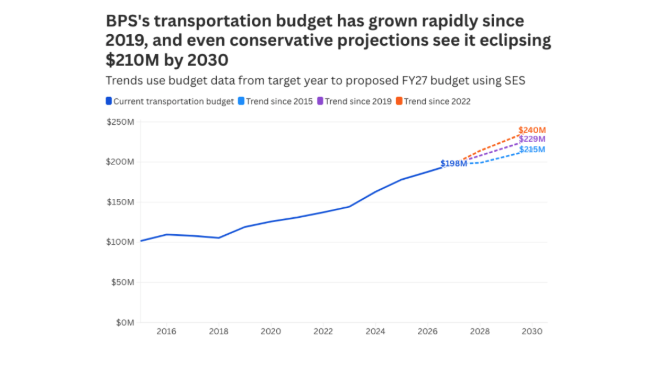
While BPS enrollment is more than 45,000, only about 22,000 students were transported by the district last year. Still, the transportation budget has grown substantially over the last decade. In 2015, BPS budgeted $101M for transportation, representing 10.4% of the total budget. In the proposed 2027 budget, transportation spending will rise 5% to $198M, representing 11.6% of the total Boston Public Schools budget. This is after more than $10M of savings from ‘operational efficiencies’ implemented in the coming year. This budget represents a 95% increase since 2015 and a 65% increase since 2019. From 2015 to 2027, transportation spending has grown by an average of 5.8% per year, outpacing total budget growth (4.8%). That gap has grown considerably since the pandemic – the transportation budget has increased by 7.3% annually since 2022, compared to the total budget’s growth rate of just 5.1%.
The April 2025 transportation report states that “Budget growth will slow and the transportation budget will decline as a percentage of the BPS Operating Budget.” Notably, the district makes no claim that the budget will decline, just that the rate of increase may slow. The line chart on this page shows the growth of the transportation budget since 2015, with the dotted lines indicating projections based on various trends. Based on the 2015-2027 budget trend, transportation spending would rise to $212M by 2030, which would be an average growth rate of just 2.5% – half the current rate. Continuing the 2019 trend would result in a budget of $226M, while a continuation of the trend since 2022 results in a nearly $240M budget. All of these projections would have lower average growth rates than what the district has seen since 2019. Even if transportation declined to the same share of the budget as it had in 2015 (10.4%), it would still be $178M in 2027, the same as it was budgeted for in 2025.
Despite repeated promises about the impact of school closures, declining enrollment, new contracts, and technical innovations, the District has failed to slow the growth of the transportation budget. Even the most optimistic cases predict transportation to remain a major cost driver, even as the district fails to meet its performance expectations and is forced to cut costs elsewhere.
To read more about the transportation budget, please click here.
BPS Presents FY2027 Budget: Staffing Cuts, Enrollment Decline, and Multilingual Program Changes | Last Night at School Committee: February 12, 2026 Meeting Recap
On Wednesday evening, the district held a hearing focused on the Central Office budget. In their presentation, district leadership stated that they prioritized "student-facing" investments that directly supported schools. Highlights from the central office budget include an $86 million increase due to four main categories: health insurance, transportation expenses, special education, and collective bargaining.
Last Night at School Committee - February 12, 2026:
Last night, the district had a two-part meeting, beginning with a Budget Hearing for FY 2027 and then a short School Committee meeting. The budget hearing largely touched on many of the same financial themes we have heard from the district before, including transportation costs and collective bargaining expenses, while also highlighting some more granular fiscal challenges at the school level. School Committee members asked a number of questions about multilingual programming, cuts to personnel, and the connection between the FY 27 budget and the long-term facilities plan.
After a brief public comment period, the meeting moved on to a discussion of a new collective bargaining agreement between School Bus Monitors and the district. Notably, this new agreement requires BPS to ask Boston City Council for an extra $1 million this fiscal year to fund the contract. We will keep tabs on how the City Council reacts to this request as well as similar asks in the future.
Here at the Shah Foundation, we wanted to provide readers with an in-depth look at some of the budget issues for FY 2027. Our team has put together the below analysis, with further commentary and statistics at the link on the bottom of the page.
Budget and Staffing:
Boston Public Schools proposed a $1.71B budget for FY2027, a 4.5% increase over the current budget, and greater than 8% increase from the $1.58B budget initially passed for FY2026. The total employee headcount for BPS will drop to 10,496, down 5% or 531 positions from FY2026. Total enrollment for the 2026 school year is just 44,416 (46,547 including in-district charters), down more than 1,600 students from 2025 – the lowest enrollment on record. This 8.3% budget increase over last year’s adopted budget is the second largest increase since FY2019. Since that year, the budget has increased by 54%, and total staffing is more than 12% higher. Over the same period, enrollment dropped by 14%, and the total number of BPS schools receiving funding has decreased to 106, down from 124.
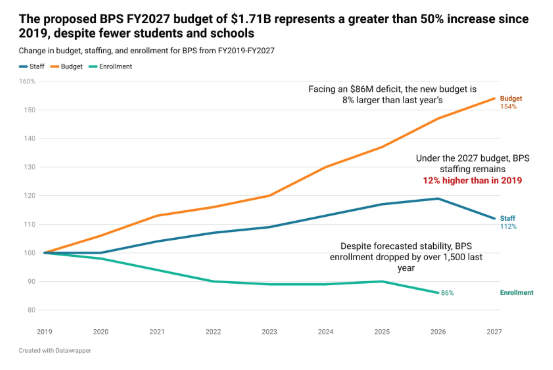
The budget increase comes largely from non-salary spending (+12%) compared to salary spending (+1%). Within salary spending, the cuts to administrators (-$3.5M) and teachers (-$6.5M) drove the bulk of the reduction, but this was offset by significant increases to spending on part-time (+$10.6M) and temporary teachers (+$4M). And despite a significant reduction in roles (-8%), the total spending on aides increased slightly (+$1.3) for FY27. Within non-salary spending, employee benefits made up the lion’s share of this increase, up to $219M in FY27, up more than 20% or $40M from the FY2026 budget. However, increases in transportation (+$8M) and purchased services (+$7M) also contributed. The budget calls for cuts of employees across all job categories, with the largest proportional cuts coming for aides, administrators, and support. As the largest group, teachers will see the highest total number of jobs cut – more than 250. Note that the total headcount for every job category except secretarial is higher than it was in 2019, and the total number of employees is only slightly below FY2024 levels.
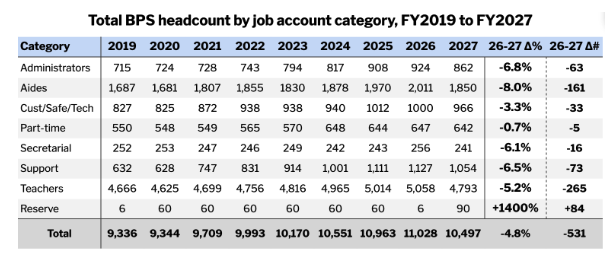
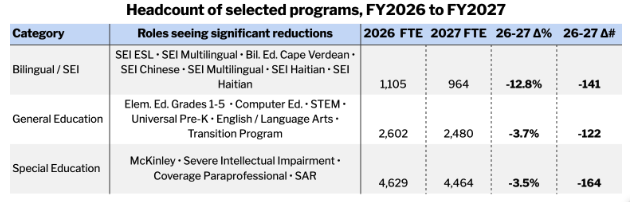
BPS also breaks down employment by program, and three program categories account for the majority of job cuts in the 2027 budget.
Biliungual / SEI has job and budget cuts to almost every program under its umbrella. ‘Bil. Ed. ESL’ will lose 20 FTEs, although its budget only decreases 1%. The ‘SEI ESL’ line item, including 4 FTEs is eliminated entirely, as is the ‘Bil. Ed. Cape Verdean’ line item. ‘SEI Haitian’ will lose 30% of its budget and FTEs.
General education sees almost all the cuts restricted to elementary education – elementary ed grade 3 will see 56 FTEs eliminated and a 62% budget cut. Universal Pre-K will see 28% or 8 of its FTEs cut. Special education sees large cuts paired with some increases – SPED McKinley has its budget and FTEs slashed by more than 50%, and ‘SPED Severe Intellectual Impaired’ will see 30% of its FTEs eliminated along with a 22% budget cut. However, ‘SEPD Generic/ Resource’ will increase its headcount and budget by more than 25% and ‘private placement’ will see a $7M budget increase. It should be noted that BPS says that some of these FTE reductions are the results of re-coding people from one job to another – particularly within bilingual programs. However, the district has not provided any actual breakdown of jobs eliminated vs. positions re-coded vs. vacancies left unfilled, leaving significant ambiguity in this analysis and for parents of BPS students.
To read more interesting analysis about next year’s budget, click here.
What’s Next:
We are in the midst of the budget process - the next budget hearing will be held on March 4th! Stay tuned for more coverage. Be well!
FY2027 Budget Season Opens: Rising Costs, Declining Enrollment, and a New Funding Formula | Last Night at School Committee: February 4th, 2026 Meeting Recap
Last night kicked off the FY 2027 budget season with an overview and a release of all the budget documents. The district’s preliminary FY27 budget proposal totals $1.71 billion, representing a $74 million increase over current spending. This increase comes even as BPS serves roughly 3,000 fewer students than last year, continuing a multi-year trend of declining enrollment. On a per-pupil basis, the district is now spending approximately $37,000 per student. What makes this especially concerning is that increased spending has not translated into improved outcomes. Only one-third of high school students are currently on track to meet BPS graduation standards, and proficiency in ELA MCAS for students in grades 3–8 has declined from 35% in 2019 to 29% in 2025. During that same period, the district added approximately 1,700 positions, raising fundamental questions about staffing growth, productivity, and accountability. Transportation costs illustrate this disconnect. The FY27 budget proposes an additional $11 million for transportation, bringing total spending on yellow buses to approximately $200 million annually, despite ongoing reports from families that buses remain unreliable and poorly coordinated.
Last Night at School Committee - February 4, 2026:
Last night kicked off the FY 2027 budget season with an overview and a release of all the budget documents. The district’s preliminary FY27 budget proposal totals $1.71 billion, representing a $74 million increase over current spending. This increase comes even as BPS serves roughly 3,000 fewer students than last year, continuing a multi-year trend of declining enrollment. On a per-pupil basis, the district is now spending approximately $37,000 per student. What makes this especially concerning is that increased spending has not translated into improved outcomes. Only one-third of high school students are currently on track to meet BPS graduation standards, and proficiency in ELA MCAS for students in grades 3–8 has declined from 35% in 2019 to 29% in 2025. During that same period, the district added approximately 1,700 positions, raising fundamental questions about staffing growth, productivity, and accountability. Transportation costs illustrate this disconnect. The FY27 budget proposes an additional $11 million for transportation, bringing total spending on yellow buses to approximately $200 million annually, despite ongoing reports from families that buses remain unreliable and poorly coordinated.
Superintendent’s Report - A Response to the Globe:
The meeting began with an executive session to discuss collective bargaining strategy with United Steelworkers Local 2936, representing bus monitors. While no details were shared publicly, we expect to hear more about this in the coming meetings. Once in public session, the Committee began by recognizing 22 National Board Certified Teachers, a reminder that individual educators continue to demonstrate extraordinary commitment to their professional growth and to their students.
Superintendent Mary Skipper then delivered an abbreviated report, including a brief comment on a Boston Globe article showing that only one-third of BPS students are currently on track to graduate under MassCore requirements. While we have been talking about this issue for months, if not years, clearly the city’s flagship paper has finally caught on to this troubling trend. The Superintendent expressed confidence that these numbers would improve in the coming months as seniors complete coursework and as the district considers exemptions for certain students in the Class of 2026.
The FY27 Budget Presentation: Financial Challenges Ahead
During last night’s budget presentation, Superintendent Skipper framed the proposal as a necessary response to rising costs, pointing to expensive health insurance premiums, transportation, special education services, and collective bargaining agreements as the most important factors. She noted that the district froze central office hiring as early as November 2025 and has since expanded spending pauses to schools. CFO David Bloom provided additional detail, explaining that the district overspent its health insurance budget by $18 million in FY26 due to higher-than-expected premium increases and a reduction in vacant positions. Transportation costs, he stated, continue to rise despite efforts to identify efficiencies, and special education spending is being driven by increased out-of-district placements and post-pandemic service needs.
Committee member Rachel Skerritt pressed district leaders on enrollment projections and how that dovetails with forecasting the budget for the coming years. District officials acknowledged that their forecasting model relies heavily on historical data and failed to anticipate the combined impact of the 2024 election and the rapid contraction of the state shelter system.
In response, the district described a plan to provide “transition support” for under-enrolled schools, two years of additional funding under certain conditions. While presented as equitable funding, the approach closely mirrors the “soft landings” model long criticized for perpetuating inefficiencies by maintaining staffing and programming in schools without sufficient enrollment.
While much of the budget discussion remained abstract, the consequences at the school level are becoming concrete. Schools such as Blackstone, Edison, Hennigan, Condon, and Charlestown High are facing staffing reductions ranging from 12% to 17%, cuts that will directly affect programming, student supports, and personnel.
Perhaps the most important exchange of the night came when Member Skerritt asked how the district could be confident that this budget would not lead to another fiscal crisis. District leaders touched on some new practices, including requiring schools to budget for benefits and eliminating positions rather than creating positions with the expectation that they remain unfilled. But that response only underscored the deeper concern: why were these safeguards not in place already?
What’s Next:
This is just the beginning of the budget process. Over the next six weeks, we will be covering the district’s budget presentation to the committees, at both school and district levels, to illustrate how BPS is navigating this challenging time. Be on the lookout for more information related to this budget cycle, as this is crucial for the future of the district.
The next meeting will be held next week on February 12th at 5:30pm. Stay warm and stay tuned for more on the Boston School Committee!
BPS Starts 2026 With New Committee Members, a $53M Deficit, and a Special Education Debate | Last Night at School Committee: January 21st, 2026 Meeting Recap
The Boston Public Schools (BPS) School Committee held its first meeting of 2026 this week, coming at a critical moment for the district with new committee members, the current $53 million budget deficit, as well as serious questions about inclusion and transparency.
Last Night at School Committee - January 21, 2026
The Boston Public Schools (BPS) School Committee held its first meeting of 2026 this week, coming at a critical moment for the district with new committee members, the current $53 million budget deficit, as well as serious questions about inclusion and transparency.
Superintendent’s Report: Staffing, Closures, and Next Steps
Superintendent Mary Skipper began her report by addressing the district’s next steps following the recent vote on school closures. Superintendent Skipper stated that BPS has held meetings with school leaders to plan transitions, assigned senior project managers to each affected school, and started reviewing student-level data to provide targeted support. Additionally, Superintendent Skipper noted the focus is on student and family transitions, staff support, and community engagement.
Later in her report, Superintendent Skipper turned to one of the district’s most urgent challenges: a projected $53 million deficit in the current fiscal year. She attributed the shortfall primarily to rising health insurance costs, filling vacant positions, additional bus routes, food services, and out-of-district special education. District leadership framed these pressures as largely external and national in scope, rather than fiscal mismanagement. Notably, there was very little public questioning from Committee members on the budget.
New Committee Members:
The Superintendent also acknowledged changes to the composition of the School Committee. Two new members, Lydia Torres and Franklin Peralta, joined the body, and Rachel Skerritt was named Vice Chair. The changes come alongside notable departures. Long-time member Michael O’Neill resigned after 17 years of service, and Brandon Cardet Hernandez was not reappointed despite applying for a second term. Known for asking tough questions and centering student outcomes, his departure raises concerns about the loss of critical oversight on the Committee.
Public Comment: Multilingual Learners Left Behind
Only five members of the public spoke during the meeting, a significant drop from recent sessions. Frequent speaker John Mudd raised serious concerns about multilingual education in BPS, and he noted that over 90% of multilingual learners are placed in English-only classrooms, while fewer than 10% are enrolled in dual-language programs. The data suggests a troubling disconnect between the district’s rhetoric on inclusion and the outcomes experienced by multilingual learners.
The Eliot K-8 Innovation School: An Ideal Model to Follow
The first report of last night was a mandatory five-year update on the Eliot K-8 School Innovation Plan. Principal Traci Walker-Griffith described a school transformation centered on multi-tiered systems of support, flexible deployment of specialists, and project-based learning, computational thinking, and AI literacy. Coincidentally, the school department published a memo on AI policy that was not mentioned during the meeting.
She emphasized that the success of the model lies not in unique resources, but in intentional systems, adult learning, and data-driven decision-making. These are tools that could be applied across the district if there is commitment to do so.
Inclusive Education: Two Divergent Visions
The most contentious portion of the meeting came during a joint presentation on services for students with disabilities. Superintendent Skipper reaffirmed the district’s commitment to inclusive education as part of the now-concluded DESE Systemic Improvement Plan.
But Edith Bazile, Chair of the Boston Special Education Parent Advisory Council (SpEdPAC), offered a starkly different assessment. She argued that BPS lacks a clear inclusion strategy, a defined timeline, and a dedicated budget. Instead of expanding successful inclusive models, she noted, the district is closing them, including nationally recognized programs like Henderson Upper School. Families, she said, were excluded from meaningful dialogue and often learned about decisions through the media.
Ms. Bazile also raised concerns about access to data, particularly data needed to assess outcomes for students with disabilities. She highlighted autism as a racial and gender equity issue, noting that nearly 80% of students with autism in BPS are male and that Black and Latino students make up the majority of these students. Inclusion, she argued, must be measured by outcomes and the district has not provided sufficient data to evaluate its own practices. Notably, what was framed as a joint presentation often felt like a public debate, revealing deep misalignment between Kay Seale, Director of Special Education for BPS, and parent advocates. The contrast raised serious concerns about communication, trust, and whether the district’s vision for inclusion is shared.
Conversation with a Former Committee Member:
Lastly, we had the opportunity to speak with former School Committee member Brandon Cardet-Hernandez. Ross and Jill asked Mr.Cardet-Hernandez to reflect on his role on the Committee as well as his take on certain issues impacting BPS. More specifically, Member Cardet-Hernandez spoke about the recent decision relating to the Madison Park rebuild, how failure of the district to adhere to MassCore requirements, as well as a number of other topics.
Here at the Shah Foundation, our team put together a deep-dive into both the renovation of Madison Park, the state of MassCore completion, and the aforementioned budget gap. To gain a clearer grasp of the district’s budget concerns, please click here. To learn more about Madison Park, please click here, and to better understand how students in BPS are handling MassCore, please click here.
The next meeting will be on February 4th at 5:30pm. We look forward to connecting with you then!
Amid Community Outcry, BPS School Committee Votes 6-1 to Close Schools — and Raises More Questions Than Answers | Last Night at School Committee: December 17th, 2025 Meeting Recap
At last night’s meeting, many important issues were discussed and decided. These included an important memo about enrollment decline, a school closure vote, and a budget update. Conversations between the Committee and district pointed to long-term issues for BPS.
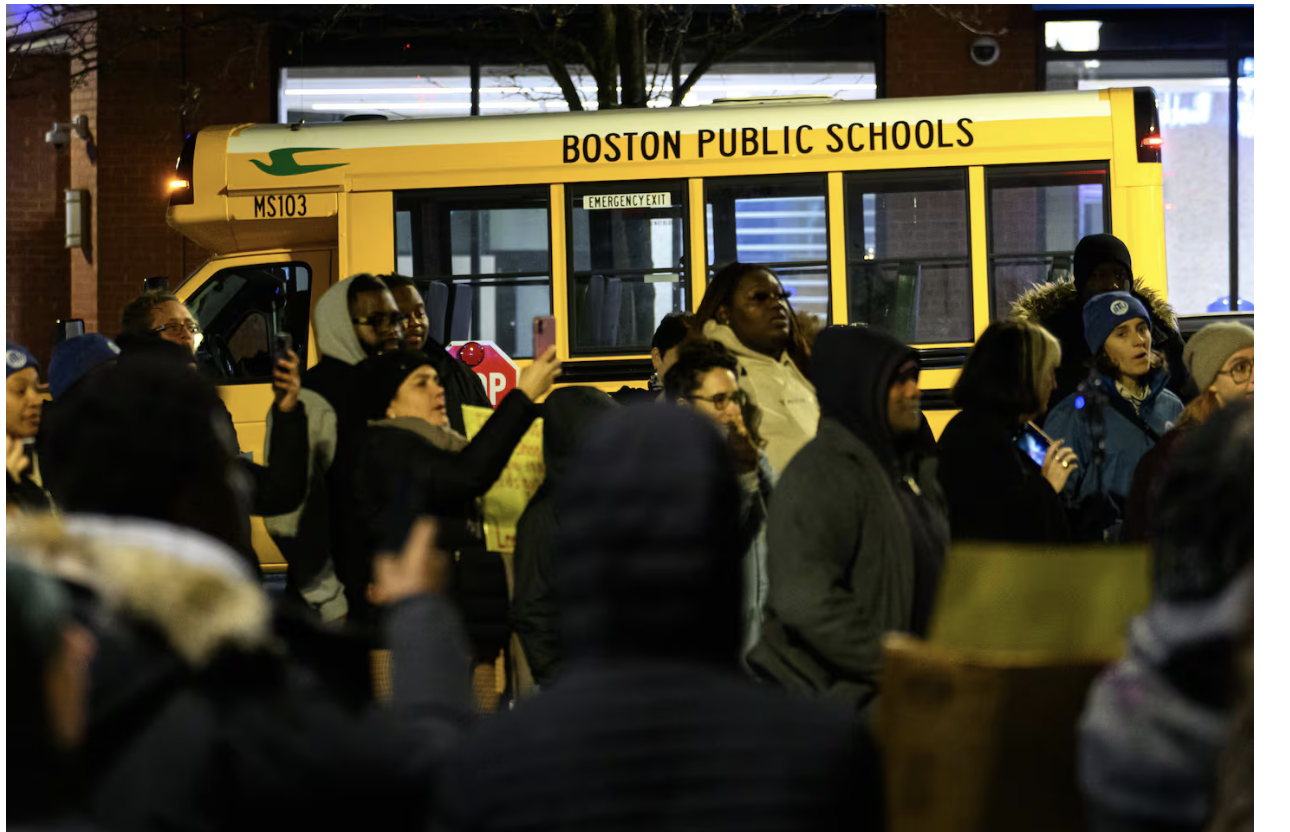
The meeting moved directly into the public comment period. There were 30 speakers, with the overwhelming majority urging the Committee to halt the proposed school closures. Testimony from teachers, parents, students, and organizers emphasized a lack of transparency, insufficient engagement, and deep uncertainty about what will happen to students once schools close. Speakers repeatedly stressed that families and educators had received vague answers to direct questions about transition plans, accountability, and the future placement of students, particularly those requiring inclusive services.
Introduction:
At last night’s meeting, many important issues were discussed and decided. These included an important memo about enrollment decline, a school closure vote, and a budget update. Conversations between the Committee and district pointed to long-term issues for BPS.
Public Comment Period:
The meeting moved directly into the public comment period. There were 30 speakers, with the overwhelming majority urging the Committee to halt the proposed school closures. Testimony from teachers, parents, students, and organizers emphasized a lack of transparency, insufficient engagement, and deep uncertainty about what will happen to students once schools close. Speakers repeatedly stressed that families and educators had received vague answers to direct questions about transition plans, accountability, and the future placement of students, particularly those requiring inclusive services.
Public comments reflected a consistent pattern of frustration and distrust. Speakers argued that the timeline for closures was rushed, poorly communicated, and intentionally scheduled during a period when families are least able to engage. Several compared the process to other recent district decisions, including exam school admissions changes, noting a recurring lack of meaningful community input.
A New Collective Bargaining Agreement:
Following public comment, the Committee unanimously approved the collective bargaining agreement between the district and the Boston Association of School Administrators and Supervisors for the 2024–2027 period. The Superintendent noted that the agreement requires a supplemental appropriation to fund the updated contract. While the vote passed unanimously, the discussion raised questions about how collective bargaining costs are cited as a driver of budget pressure while receiving limited scrutiny during approval.
The School Closure Vote:
The most anticipated item of the evening was the vote on school closures. Chair Robinson framed the decision as part of a broader strategy to improve academic outcomes, address underutilized facilities, and strengthen the district’s long-term sustainability. Superintendent Skipper emphasized declining enrollment, excess capacity, and the need to concentrate resources in fewer schools, referencing the district’s long-term facilities framework and enrollment projections as justification for the closures.
Committee members expressed significant unease ahead of the vote. Several members raised concerns about students who have already experienced multiple school transitions due to prior closures and questioned whether the district has tracked outcomes for those students. Others noted confusion around the district’s emphasis on facilities, particularly in cases where school buildings remain in usable condition. Members also highlighted broader systemic failures, including the absence of a clear, actionable long-term facilities plan and a history of delayed accountability.
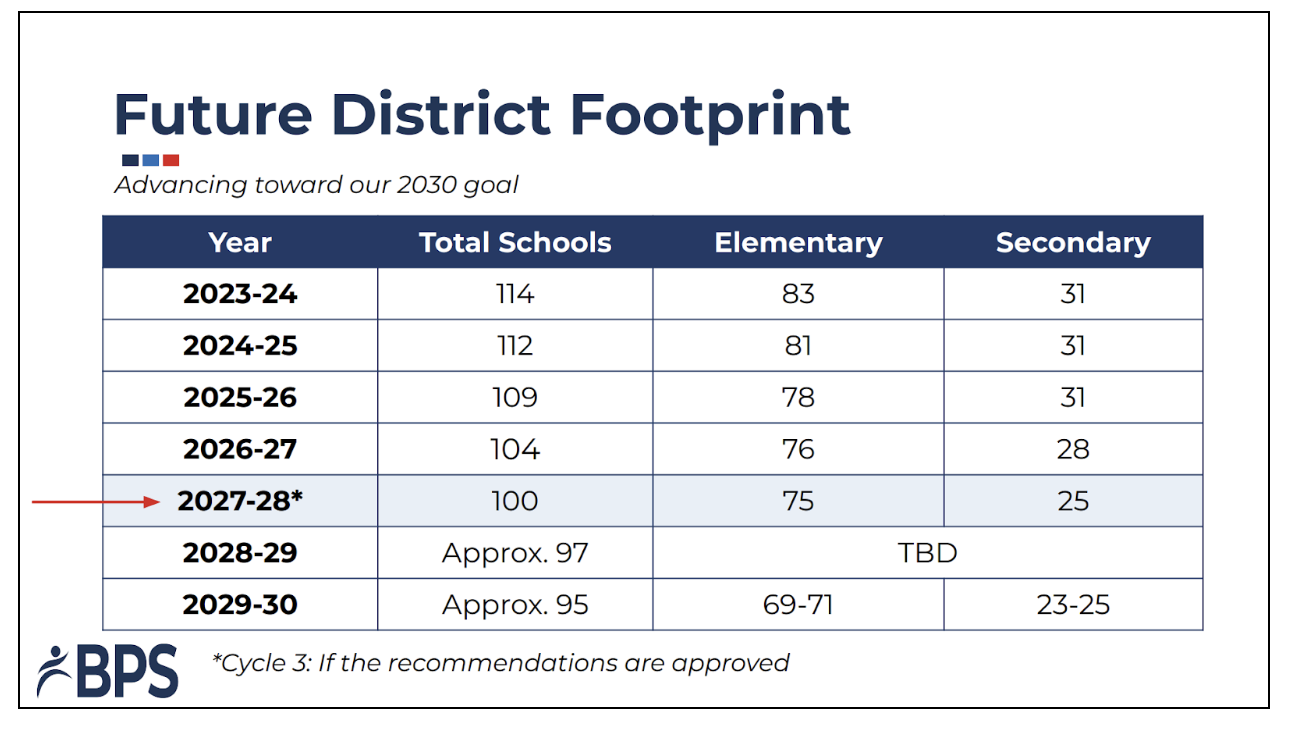
Despite widespread concern, unresolved questions, and visible discomfort among several members, the Committee approved the school closure plan by a vote of six in favor and one opposed. The discussion made clear that some members viewed the vote as a necessary fiscal decision rather than an educational one, underscoring the tension between budget realities and student-centered outcomes.
A Financial Update:
The final presentation of the evening focused on the district’s financial outlook as budget season begins for the Committee. Superintendent Skipper described mounting fiscal pressures, including rising healthcare costs, collective bargaining agreements, transportation expenses, special education costs, and continued enrollment decline. District leadership also introduced the transition from weighted student funding to a new rules-based funding formula, intended to more equitably fund schools and provide greater transparency.
Chief Financial Officer David Bloom explained that the new funding model prioritizes required staffing and non-personnel costs before allocating remaining resources, marking a shift away from per-pupil funding. District leadership emphasized that transition support will be provided to schools over the next two years, as the shift occurs. Committee discussion highlighted the district’s nearly $150 million transportation budget, inefficiencies in service delivery, and parallels between rising healthcare and transportation costs. Members raised concerns about accountability and questioned whether longstanding inefficiencies are being meaningfully addressed.
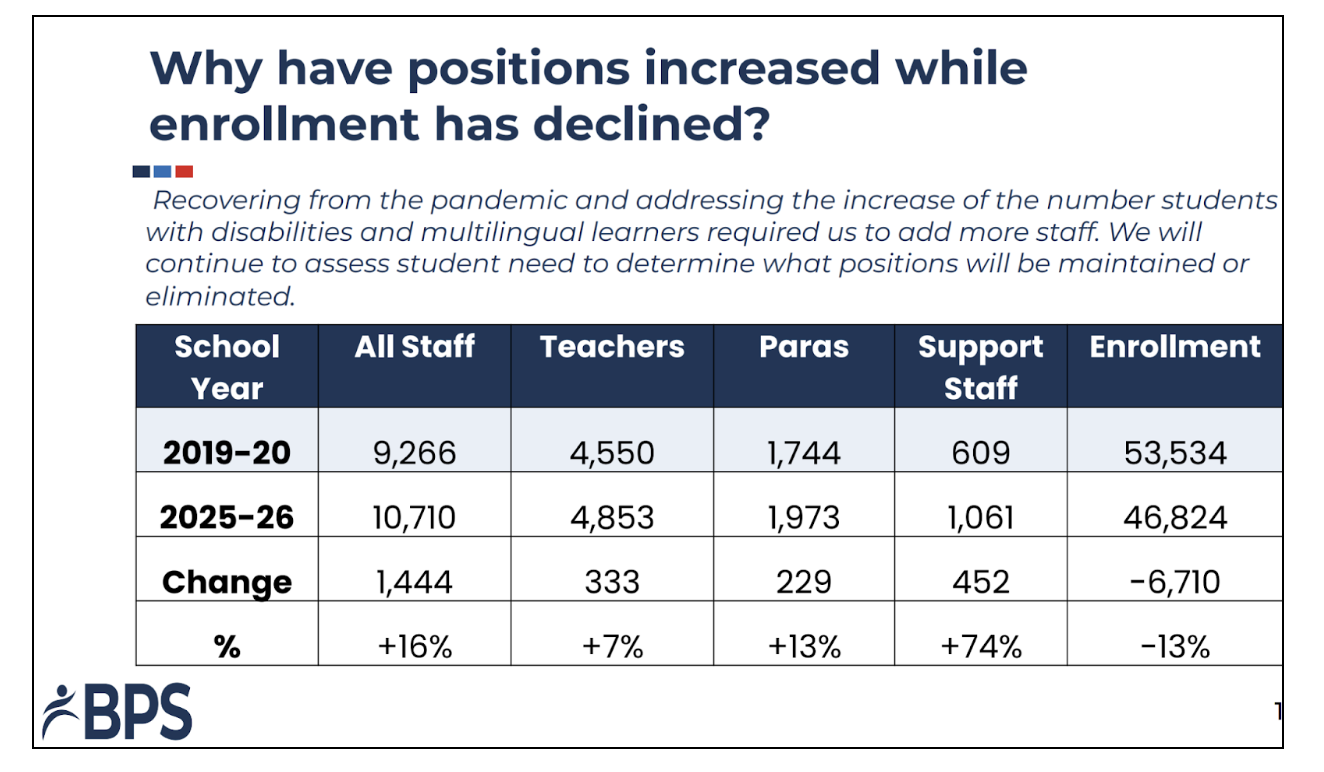
Committee members also questioned the growth in support staff amid declining enrollment. District officials indicated that staffing reductions will largely affect classroom teachers and paraprofessionals, while attempting to preserve positions tied to inclusive education and student support services. Estimates suggest that several hundred positions may be eliminated as enrollment continues to fall and schools close, reinforcing concerns about the district’s long-term workforce planning.
A Closing Recognition and Looking Ahead:
The meeting concluded with the Committee honoring Vice Chair Michael O’Neill for his 17 years of service to the BPS and the City of Boston.
The next public meeting will be held virtually on January 21st, 2026 at 5:30pm. In the meantime, we hope everyone has a wonderful holiday season filled with health, joy, and community. We will see you in the new year!
School Closure Opposition, Inclusive Education Update, and Bilingual Programming Take Center Stage | Last Night at School Committee: December 3rd, 2025 Meeting Recap
The meeting opened with an executive session to discuss a tentative agreement with the Boston Association of School Administrators and Supervisors (BASAS), which the Committee will vote on at its next meeting on December 17th. Additionally, the Committee recognized Taylor McCoy, an Inclusion Specialist at Mattahunt Elementary School, as the 2025 Shattuck Award recipient. Members celebrated her dedication as well as the work of countless educators who serve students every day.
The meeting opened with an executive session to discuss a tentative agreement with the Boston Association of School Administrators and Supervisors (BASAS), which the Committee will vote on at its next meeting on December 17th. Additionally, the Committee recognized Taylor McCoy, an Inclusion Specialist at Mattahunt Elementary School, as the 2025 Shattuck Award recipient. Members celebrated her dedication as well as the work of countless educators who serve students every day.
Public comment was emotional and dominated by strong opposition to the proposed school closures, including Another Course to College (ACC), the Community Academy of Science and Health (C.A.S.H.), the Henderson Inclusion School, and Lee Academy. There were 60 speakers scheduled to comment at the meeting, though the actual number of speakers was closer to 50. Students, parents, teachers, and community members emphasized the importance of each school community and the lack of clear transition plans for impacted students. Speakers also pointed to the contrast between the district’s update on inclusive practices and the forthcoming vote to close many schools with high-needs students. Additionally, in response to requests from the public, Committee Members Skarrett and Cardet-Hernandez requested that the district present detailed transition plans for students.
For the fourth meeting in a row, public speakers also raised concerns about the lack of citywide bilingual education programming and urged the district to expand multilingual learner support. The district released a memo to the public about proposed expansion prior to the meeting. Notably, the findings from the district underscored the cost of transportation for students as a major challenge in developing citywide programming. In a separate memo released earlier in the day, the district announced that a system-wide cell phone policy will be released in 2026. We will continue to monitor how this situation plays out.
Ross and Jill discuss the cost of expanding dual-language programming.
The only report of the evening focused on the district’s progress toward implementing inclusive education. Superintendent Skipper framed the update as a continuation of the district’s 2022 strategy to move all schools toward inclusive classroom models. BPS previously submitted its Inclusive Education Plan to DESE in October 2023 as part of the Systemic Improvement Plan. District staff described improvements over the past three years and highlighted tools and practices they believe are beginning to show positive student outcomes.
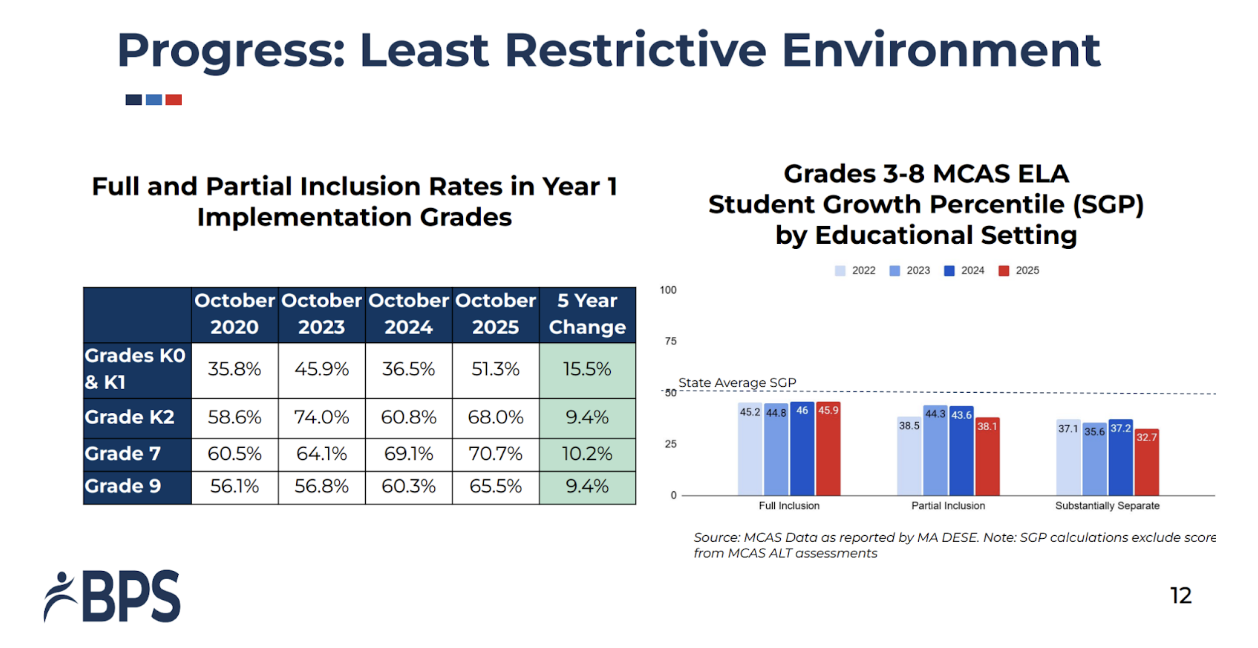
Committee members raised multiple concerns about implementation, clarity, and outcomes. Member Cardet-Hernandez questioned why some schools’ student populations still do not reflect district demographics and pushed the district on protections against over-identification of Black boys and multilingual learners for substantially separate placements. District staff acknowledged ongoing concerns, noting that although the rate of substantially separate placements has decreased to 30.7%, it remains unacceptable.
Member Alkins asked directly about the challenges the district still faces in implementing inclusive practices. The response focused on professional development and cross-functional collaboration rather than on student outcomes or systemwide effectiveness. Member Skerrett pressed for clear benchmarks and targets to measure whether inclusion efforts are actually improving student progress. The presentation offered few concrete indicators, raising lingering questions about outcomes as well as how the district will measure success during upcoming budget discussions.
Long-Term Facilities Plan Presented as Enrollment Drops and Closure Concerns Mount | Last Night at School Committee: November 19th, 2025 Meeting Recap
The Superintendent began with updates on transportation and enrollment, noting that the district has seen record-high transportation performance this fall. Morning on-time performance has reached 95% or higher on nine separate days, a remarkable increase given that in past years BPS only hit that mark twice during the first 45 days of school. Member Cardet-Hernandez, however, inquired about the headline the Superintendent avoided mentioning: the recent bribery and kickback scheme involving a Transdev employee, and the long-standing oversight failures that allowed uncertified drivers and other safety lapses to occur. The Superintendent stated that the latest transportation contract includes stronger accountability provisions, but did not elaborate on what those measures look like.
Last Night at School Committee - November 19th, 2025:
Here’s what happened Last Night at the Boston School Committee meeting.
Superintendent’s Report:
The Superintendent began with updates on transportation and enrollment, noting that the district has seen record-high transportation performance this fall. Morning on-time performance has reached 95% or higher on nine separate days, a remarkable increase given that in past years BPS only hit that mark twice during the first 45 days of school. Member Cardet-Hernandez, however, inquired about the headline the Superintendent avoided mentioning: the recent bribery and kickback scheme involving a Transdev employee, and the long-standing oversight failures that allowed uncertified drivers and other safety lapses to occur. The Superintendent stated that the latest transportation contract includes stronger accountability provisions, but did not elaborate on what those measures look like.
The Superintendent then shifted to enrollment, reporting that the district currently serves 46,824 students, an astonishing drop of 1,700 students from this time last year. She attributed the decline to reduced international immigration, fewer children being born in Boston, and smaller cohorts moving through the system. Vice Chair O’Neill followed with questions about how this compares to projections, how much revenue depends on enrollment, and what the district expects for next year. In response, CFO David Bloom explained that Boston’s budget is largely insulated from enrollment declines because city appropriations are not tied to student count. Instead, the budget is tied to local taxes. Moreover, supplemental state and federal grants are based on prior-year enrollment, so the shifts will not have any impact on this coming year.
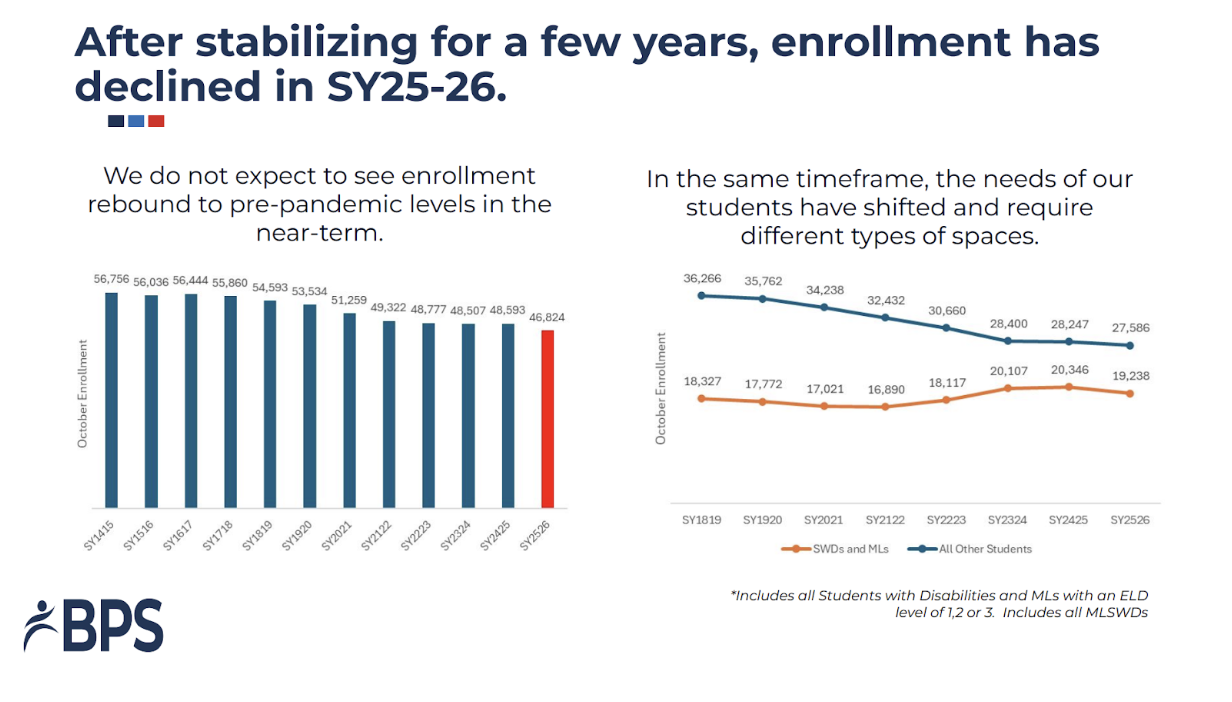
The district also presented the below data on graduation rates throughout the district. Embedded in a memo circulated to the School Committee, members had long been clamoring for more clarity on these numbers:
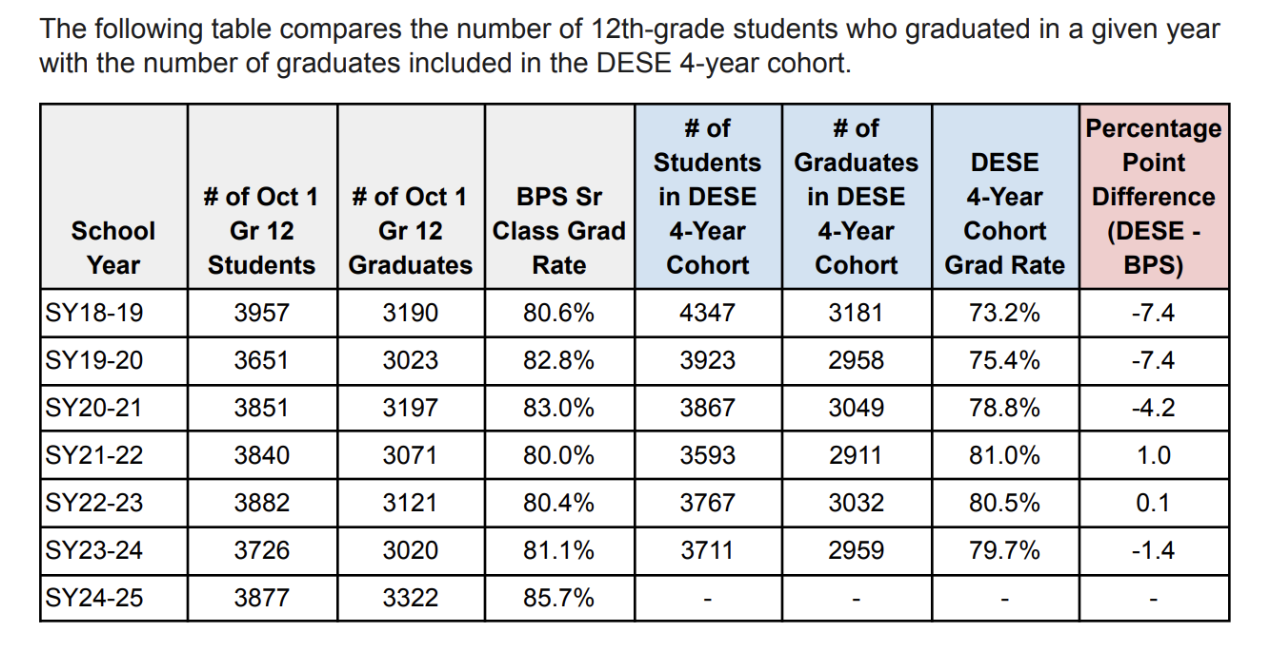
Public Comment and Facilities Tensions:
Public comment was particularly emotional last night, fueled by the long-term facilities plan scheduled for presentation later in the meeting. Before speakers took to the mic, Superintendent Skipper attempted to clarify that no vote would occur last night and that the December 17 meeting would be the earliest opportunity for action. This preface did little to dissuade speakers, who filled the session with concerns about proposed school closures and reorganizations. Parents, teachers, and students voiced deep pride in their school communities and urged the district to slow down, reconsider, or postpone closures. Others highlighted the need for more multilingual programming and raised concerns about equitable access for out-of-district students seeking admission to BPS.
The Long-Term Facilities Plan:
The main report of the evening was the long-term facilities plan. Superintendent Skipper framed the work as an effort to align buildings with a shared definition of a high-quality student experience. She asserted the vision is one informed by thousands of surveys, listening sessions, and community engagements. Superintendent Skipper also emphasized that decades of deferred maintenance and sharply declining enrollment have made this planning unavoidable.
Chief of Capital Planning Delavern Stanislaus then presented an in-depth review of the district’s proposed school closures, mergers, and reconfigurations. The plan includes closing Lee Academy Pilot School, Another Course to College (ACC), and the Community Academy of Science and Health (CASH); restructuring the Henderson School into a unified PreK–8 program; and reconfiguring both Tobin and Russell into PreK–6 schools. Stanislaus also previewed a broader arc of closures, noting that by 2030, the district anticipates approximately eight additional elementary schools and six high schools will ultimately close.
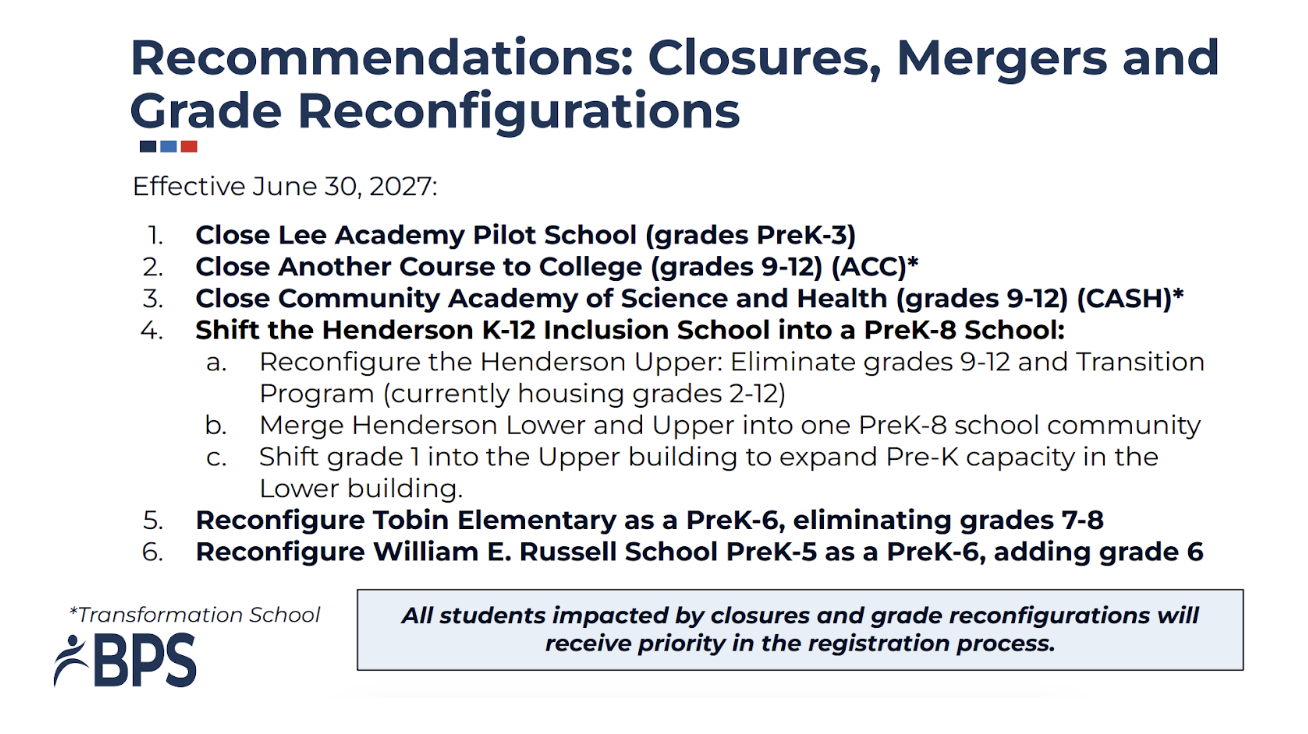
In response to the presentation, Member Cardet-Hernandez highlighted one of the most troubling data points: 39 students who will be displaced in this current slate of closures had been previously impacted before! He urged the district to ensure these students receive a different, more supportive experience this time, while also taking steps to prevent repeated disruption as future closures roll out.
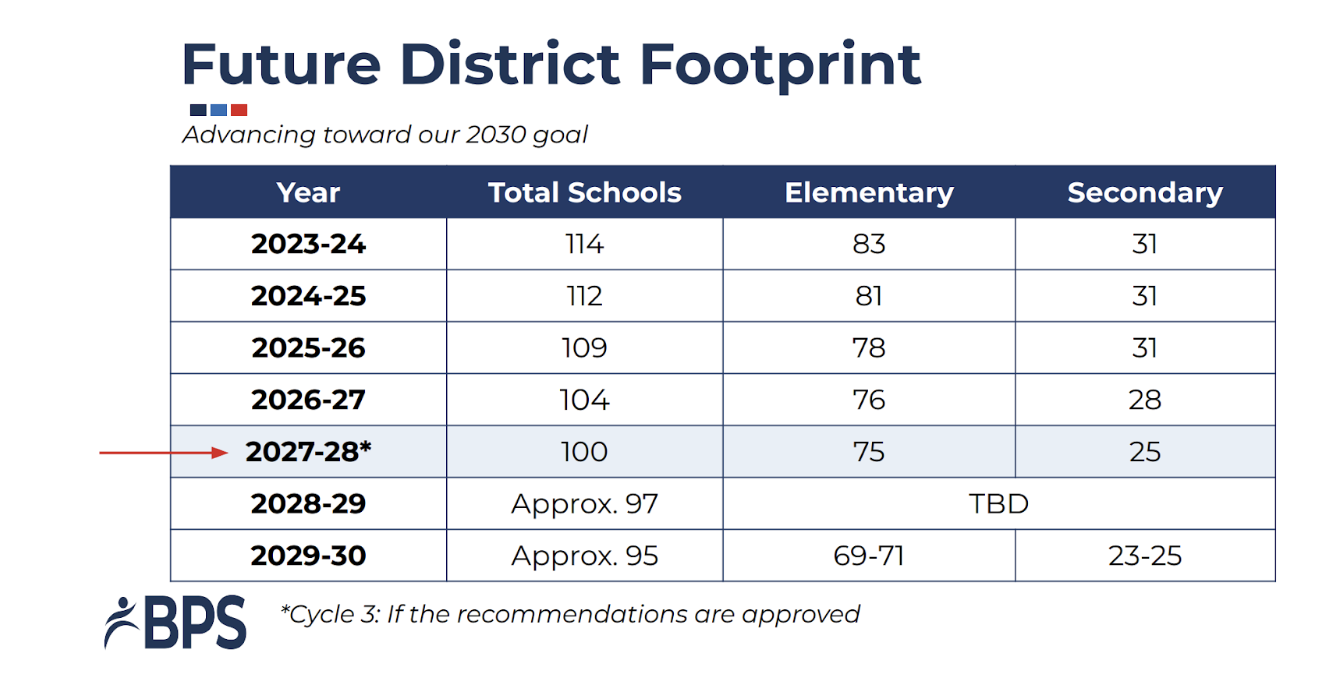
What’s Next:
The next School Committee meeting will be held on December 3rd at 6pm, and the vote on the long-term facility proposals will be held on December 17th. In the interim, we hope everyone has a wonderful Thanksgiving holiday!
Exam School Admissions, Competency Determination, and Graduation Standards Voted On | Last Night at School Committee: November 5th, 2025 Meeting Recap
Last night’s Boston School Committee meeting was filled with votes on various topics crucial to the future of the district, including an adjustment to the Exam School Admissions Policy as well the Competency Determination for the Classes of 2026 and 2027.
Last night’s Boston School Committee meeting was filled with votes on various topics crucial to the future of the district, including an adjustment to the Exam School Admissions Policy as well the Competency Determination for the Classes of 2026 and 2027. Here’s what happened:
Superintendent Mary Skipper opened with how the district is responding to the federal pause on SNAP benefits. She emphasized that all students will continue to receive free breakfast and lunch at BPS sites and highlighted ongoing school-based food drives and a centralized drive at the Bolling Building.
The Committee reviewed and advanced a new group of members for the Opportunity & Achievement Gaps (OAG) Task Force, which advises and holds the district accountable for a shared plan to close equity gaps. The updated slate of members were unanimously approved by the Committee later in the evening.
There were 32 speakers during the public comment period, and many addressed the pending exam school admissions vote, but the night also featured a notable student call for a formal district AI framework, including teacher training and certification for responsible use. Additionally, a number of speakers, once again, urged expansion of dual-language programs, echoing similar requests from last week. It will be interesting to monitor whether the Committee moves forward with this request due to the high volume of testimony.
In a long-awaited vote, last night was the culmination of months of testimony, presentations, and discussion regarding a change to the Exam School Admissions policy. Superintendent Skipper framed the proposal as a compromise of keeping the benefits of the old system while tweaking other aspects. The recommendation preserves the socioeconomic tier structure while adding a citywide pathway for top-scoring students. In speaking about the decision, Member Stephen Alkins urged deeper equity analysis and simulations to surface nuance for marginalized populations who comprise the district’s majority. Member Rachel Skerritt stressed the core issue in the district: across BPS, there are not enough students meeting grade-level standards in ELA and math to fill the ~1,000 seventh-grade exam school seats.
The adjusted policy passed the committee, with 4 members in favor and 2 members opposed (with one member absent).
Jill talks about how the district sets expectations for students.
After the exam school vote, the Committee then considered three more votes:
Chapter 74 (CTE) Admissions Policy for five high schools (Madison Park, English High, Boston Arts Academy, Boston Green Academy, and EMK).
Middle School Career Exploration policy to better inform students about CTE pathways earlier.
Updated Competency Determination (CD) policy aligned to DESE’s summer 2025 changes (the Committee had approved a BPS CD framework in June 2025; this update brings it into compliance with DESE’s revisions).
Member Skerritt sought clarity on what Competency Determination now means for the Classes of 2026 and 2027 versus graduation requirements. She emphasized that the competency determination is a temporary substitute for grade-10 MCAS as a graduation gate and does not equal a diploma. Instead, it’s merely one eligibility condition alongside MassCore and successful completion of four years of study.
Embedded within the district’s presentation on this topic were two key infographics that highlight some of the key issues here. The first paints a picture of how the district defines “mastery” for students, along with indicator that a “D-” signals proficiency:
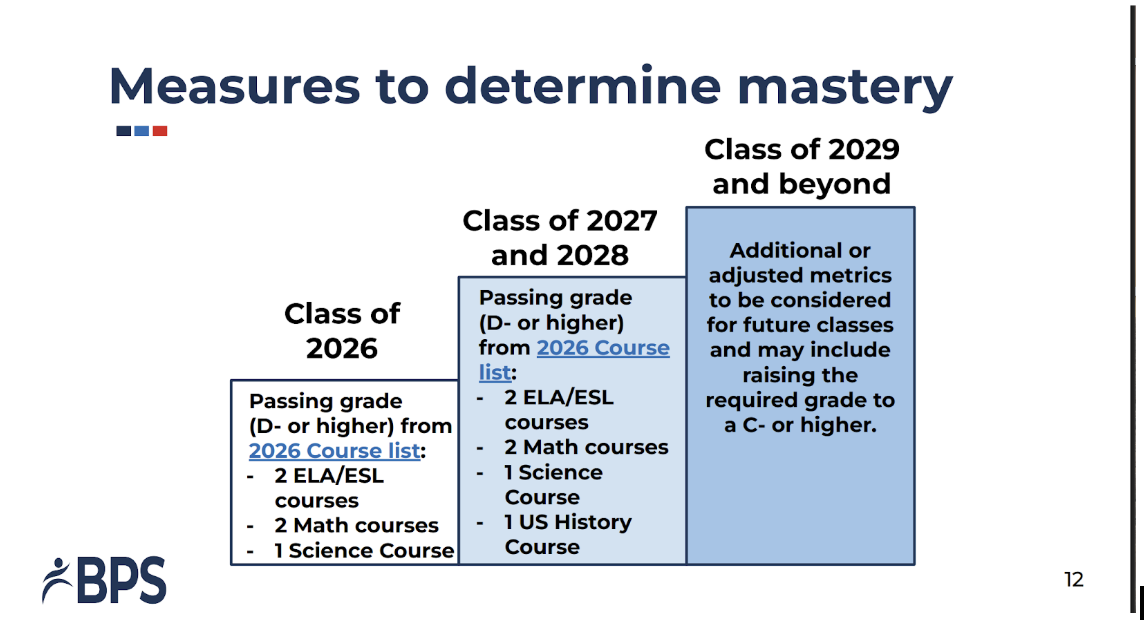
The second graphic illustrates the number of students from the Class of 2026 that are on track to graduate with MassCore. Some of these numbers are really worrisome, and this data underscores the myriad of challenges that the district faces in implementing MassCore:
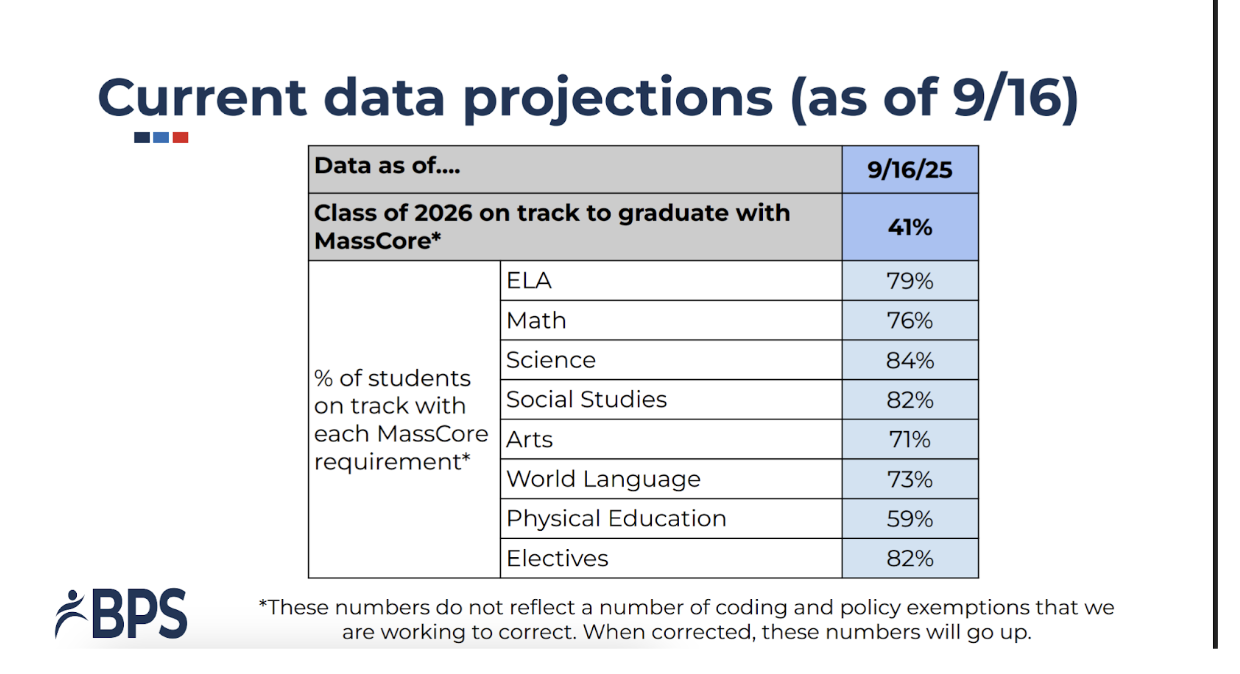
Enrollment Trends, Superintendent Contract, and Transformation School Progress Reviewed | Last Night at School Committee: October 29th, 2025 Meeting Recap
Last night’s Boston School Committee meeting covered a wide range of topics, including declining enrollment, the Superintendent’s contract and an update on transformation schools.
Last night’s Boston School Committee meeting covered a wide range of topics, including declining enrollment, the Superintendent’s contract and an update on transformation schools.
Superintendent’s Report:
The meeting began with a Superintendent’s Report. Superintendent Mary Skipper opened by reflecting on the previous night’s “State of the Schools” address, sharing that there was “more pep in the step” throughout central offices following Mayor Wu’s remarks. She also celebrated the opening of several newly renovated schools, upcoming international travel opportunities for students, and an award earned by the BPS Food Team for their work in providing healthy, delicious meals across the district.
Enrollment and Graduation Rates:
Following the report, Member Brandon Cardet-Hernandez raised two key questions about district trends, enrollment and graduation rates, both of which have been ongoing areas of concern.
Superintendent Skipper confirmed that enrollment is declining across the district, particularly among “newcomer” students, whose numbers are “roughly half” of what they were last year. She explained that while BPS is working to support families, several upcoming cohorts will be smaller, a trend driven by both post-COVID demographic shifts and broader declines in birth rates. The Superintendent also noted that a more complete enrollment report will be presented in November. As for graduation rates, Skipper said that while internal numbers suggest an increase in June graduations and a “robust summer cohort,” final figures will not be available until the state releases official data later in the school year.
Public Comment and the Upcoming Exam School Vote:
During public comment, 33 speakers addressed the Committee, with many focused on the exam school admissions policy. The upcoming vote on this issue will take place next week, and the evening featured impassioned arguments on both sides of the debate, some defending the current system with others pushing for policy shifts. In addition to the exam school discussion, quite a few speakers advocated for increasing access to dual-language programming for students across the district.
Superintendent’s Contract Discussion:
The Committee then voted to approve several grants before turning to a discussion of Superintendent Skipper’s new contract. In framing the conversation, Superintendent Skipper spoke passionately about her commitment to Boston and the mission of BPS. Absent in the discussion, however, was a lack of benchmarks or goals tied to Skipper’s renewal. Member Cardet-Hernandez echoed this sentiment, and he called for a more calibrated and evidence-based evaluation process.
Transformation Schools Accountability Update:
The Committee then heard an update on Transformation Schools, schools identified by the state as requiring targeted intervention. Superintendent Skipper noted that while there are “signs of progress,” persistent challenges remain, including low student achievement and chronic absenteeism. She highlighted that for the third consecutive year, more schools improved their accountability percentile than declined, with 18 schools improving and eight remaining steady.
Member Cardet-Hernandez called the presentation both encouraging and sobering, noting that despite incremental gains, roughly one-third of BPS schools remain in transformation status, serving the highest concentrations of Black, Latino, low-income, multilingual, and special education students. And while it is a positive that the district continued to present this update even though it is no longer mandated, a lot more work needs to be done.
State of the Schools Address:
On this episode, we had a special guest, Greg Maynard, from the Boston Policy Institute to discuss the first ever State of the Schools address from Mayor Michelle Wu. While the Mayor touted new bilingual education, an increase of air conditioning units, and improvement on transportation times, there were a number of more thorny issues that the Mayor avoided.
The speech stopped short of confronting the district’s most pressing challenges. For instance, while Mayor Wu cited examples of students taking advanced coursework, her discussion of overall academic performance was minimal. Mayor Wu did not address Boston Public Schools’ recently released MCAS results, which remain far below pre-pandemic levels. Fewer than 30% of students in grades 3–8 met expectations in both ELA and math, down more than five percentage points from 2019. Likewise, while Mayor Wu has previously pointed to major capital investments in BPS facilities, more than half of all students still attend schools rated as “inadequate” under the district’s own building experience measure. Over 50% of buildings also lack a full continuum of services, including English learner and special education programs.
Finally, on transportation, Wu noted that 96% of school buses arrived on time yesterday but did not address the district’s long-term failure to meet the standards required under the 2022 Systemic Improvement Plan (SIP), which set a monthly 95% on-time goal. Public data show the district and its embattled contractor, Transdev, have not met that standard once since the plan began. The annual on-time rate for 2024–25 was 90%, and through the first month of the 2025–26 school year, just 88% according to a public records request.
Mayor Wu’s State of the Schools address was an important opportunity to confront these challenges head-on. While progress is real, it remains uneven. Test scores are low, facilities are deteriorating, and key obligations to the state remain unmet. Mayor Wu has the political mandate and resources to act decisively; the question is whether the Mayor will use them.
To read the full speech, please click here.
What’s Next:
The next meeting will be held next Wednesday, November 5th at 6pm. The School Committee will vote on the proposed Exam Schools Admissions Policy shift. We look forward to connecting with you next week!
Exam School Simulations, Graduation Standards, Summer Learning, and MCAS Results Reviewed | Last Night at School Committee: October 8th, 2025 Meeting Recap
At last night’s Boston School Committee meeting, members dove immediately into another discussion about the Exam School Admissions Policy Recommendation, foregoing the usual Superintendent’s Report. In response to committee requests from the last meeting, the district presented new simulations that gave equal weight (as opposed to 70% grades and 30% MPA score) to both GPA and MAP assessment scores. The district found that there was minimal change in the overall makeup of students admitted to exam schools.
Last Night at School Committee - October 8, 2025:
At last night’s Boston School Committee meeting, members dove immediately into another discussion about the Exam School Admissions Policy Recommendation, foregoing the usual Superintendent’s Report. In response to committee requests from the last meeting, the district presented new simulations that gave equal weight (as opposed to 70% grades and 30% MPA score) to both GPA and MAP assessment scores. The district found that there was minimal change in the overall makeup of students admitted to exam schools.
Public Comment:
There were 21 speakers during public comment, with most urging the Committee to delay the exam school admissions policy change. The reasons were twofold: that the district’s community engagement process has been insufficient, and that any policy shift would risk rolling back progress on diversity. Others spoke about creating a districtwide AI policy, discussed MCAS results, and requested official district holidays for Rosh Hashanah and Yom Kippur.
Secondary Schools Policy Update:
The Committee then moved through grant approvals and then heard a report on secondary school policies, including graduation and vocational admissions criteria. The Committee discussed adding weighted lotteries for all vocational programs, spurring questions about the complexities of admissions for families.
District leaders outlined new competency determination requirements to align with updated state (DESE) standards for the Class of 2026 and beyond, with adjustments for multilingual learners, students with disabilities, and those with exceptional circumstances. Embedded in the district’s presentation was also a recommendation for a watered-down MassCore with a “D-” signaling mastery in certain courses. This raised concerns about expectations and abiding by the previous Committee votes to use MassCore as the graduation standard.
Additionally, the district failed to present data for the Class of 2025, prompting Member Brandon Cardet-Hernandez to question how many students are currently on track to meet graduation standards. He noted that in the presentation disseminated by the district only 41% of the Class of 2026 appears to be on pace to complete MassCore, and therefore graduate.
Summer Learning Initiatives:
Next, the Superintendent presented on Summer Learning 2025, reporting participation from 14,600 students, up 600 from the previous year. The district highlighted stronger collaboration across departments and improved multilingual family communications. However, outcomes from these summer programs were nonexistent.
Member Cardet-Hernandez questioned whether the district is truly committed to evaluating outcomes. He pressed for evidence that these expensive programs are actually closing achievement gaps. Member Skerritt echoed that same concern, asking for longitudinal tracking of student outcomes, noting that with today’s data tools, the district should be able to easily compare participants’ attendance, growth, and testing results to prior years.
MCAS and Accountability Results:
The final report of the night centered on 2025 State Assessment and Accountability Results. Superintendent Skipper cited “encouraging progress” in literacy for grades 3–8 and said Boston outperformed other large districts statewide.
But a closer look revealed troubling trends. Member Cardet-Hernandez questioned the effects of “social promotion,” advancing students who haven’t met grade-level standards, and how this impacts high school achievement. Member Skerritt then asked what proficiency targets the district is actually aiming for, suggesting BPS set clear districtwide goals through 2030.
As the below chart indicates, MCAS scores remain below pre-pandemic levels across all grades:
Despite these declines, the district framed the results as “encouraging,” a characterization that is difficult to reconcile with the data.
What’s Next:
The meeting was emblematic of the district’s current crossroads: a push for optimism and narrative control amid academic stagnation. The next meeting will be held on October 29th. We look forward to connecting with you then!
Exam School Admissions Policy Change Proposed: Tier Structure, Citywide Round, and Equity Concerns Debated | Last Night at School Committee: September 25th, 2025 Meeting Recap
The Boston School Committee held their second meeting of the school year last night, primarily to present a proposal to change the exam school admissions policy. This was the sole report of the meeting and much of the public comment surrounded this proposal.
After the Superintendent’s report, Member Cardet-Hernández pressed for updates on graduation rates and summer school outcomes. Superintendent Skipper noted those would come at the October 8th meeting, alongside official enrollment numbers.
The Boston School Committee held their second meeting of the school year last night, primarily to present a proposal to change the exam school admissions policy. This was the sole report of the meeting and much of the public comment surrounded this proposal.
After the Superintendent’s report, Member Cardet-Hernández pressed for updates on graduation rates and summer school outcomes. Superintendent Skipper noted those would come at the October 8th meeting, alongside official enrollment numbers.
Exam School Admissions Policy Recommendation:
The district formally presented its recommended changes:
Remove all school-based points, which Skipper described as confusing, inequitable, and less impactful over time.
Reduce housing-based points from 15 to 10 points, aligning with observed differences in composite scores.
Add a “citywide round”: the first 20% of seats at each exam school would go to applicants with the highest composite scores citywide, regardless of tier.
Maintain the current four-tier structure, based on neighborhood population, not applicant numbers.
Superintendent Skipper emphasized that these changes would ensure fairness, prevent inflation of scores above 100, and preserve the original intent of the 2021 policy. However, School Committee members raised important questions about the implications of the policy shifts. For instance, Member Polanco García pressed for plans to better support newcomers and English Language Learners, whom Skipper admitted still lack sufficient resources. Meanwhile, Member Rachel Skerritt sought clarity on whether the proposal preserves equity while creating a pathway for the city’s highest achievers. She also noted the district’s failure to deliver on earlier promises to strengthen rigor in grades 4–6, which was promised five years ago. Zooming out a bit, Member Cardet Hernández questioned why BPS continues to frame admissions around three schools instead of tackling system-wide quality, noting families’ desire for options across all grades. And Member Stephen Alkins asked about the drop in projected Black student enrollment (from ~20% to 15%) and urged more transparency in data and grading practices. To cap it all off, Chair Robinson underscored the Committee’s failure to improve early-grade preparation, warning that focusing solely on exam school admissions leaves thousands of other students behind. Clearly, members have many questions, and it is unclear if this policy change will meet the stated goals of clarity, stability, and simplicity.
BPS Opens School Year With New Committee Member, Back-to-School Updates, and Exam School Admissions Discussion | Last Night at School Committee: September 10th, 2025 Meeting Recap
The Boston School Committee met last night for its first meeting of the school year. The meeting covered a wide range of topics, from the district's back-to-school updates to the ongoing discussion of the exam school admissions policy. Here’s a recap of what happened:
The meeting kicked off with a warm welcome to the newest member of the Boston School Committee, Rachel Skerritt. Skerritt, who has previously served as Head of Boston Latin School, is joining the committee and brings a fresh perspective to the group. We are looking forward to hearing from her in the months and years ahead.
The Boston School Committee met last night for its first meeting of the school year. The meeting covered a wide range of topics, from the district's back-to-school updates to the ongoing discussion of the exam school admissions policy. Here’s a recap of what happened:
The meeting kicked off with a warm welcome to the newest member of the Boston School Committee, Rachel Skerritt. Skerritt, who has previously served as Head of Boston Latin School, is joining the committee and brings a fresh perspective to the group. We are looking forward to hearing from her in the months and years ahead.
Mayor Wu Makes a Surprise Appearance:
Mayor Michelle Wu kicked off the meeting with a heartfelt welcome to the Boston school community. The Mayor touched upon some major areas of improvement for the district, including better transportation arrival times. The Mayor and Superintendent complimented each other for their partnership in overcoming enduring challenges across the system.
Superintendent Mary Skipper began her report with a comprehensive overview of how the first days of school have been going. She highlighted some key areas and spoke to some important data points that illuminate both weaknesses and strengths throughout BPS
Enrollment Numbers: As of the first week of school, enrollment was just over 48,000 students, with 2,400 new registrations since June. However, the district cautioned that enrollment numbers would fluctuate, especially as the district waits for students to report.
Attendance: The first day attendance was 78.8%, a two-point increase from the previous year. By the end of the week, that number rose to 79.8%, showing steady improvement. Yet, this is still alarming as it means that 1/5 children are not showing up to their school.
Transportation: The district touted its best-ever on-time performance for school buses. While the numbers are up, 3 out of 10 kids are still arriving late to school, which remains a significant issue, considering the $188 million spent on school transportation. For comparison, other districts like Newark, New Jersey, spend $105 million less for similar levels of service.
Several public comments touched on a variety of pressing issues:
Exam School Admissions: Some speakers questioned the fairness and impact of the current admissions policy, which continues to generate debate in the district.
Inequality and Achievement Gaps: One speaker made a passionate appeal for a more transparent, equity-centered approach to school closures, emphasizing the need for a master facilities plan that addresses historical disparities and ensures students' needs are met.
Support for English Language Learners: There were calls for more tailored support for English Language Learners, particularly given the increase in multilingual immigrant students in the district.
Disability Support: One parent spoke about the district’s failure to properly support students with disabilities, sharing her own experience navigating the IEP process.
The committee spent a significant portion of the meeting discussing the exam school admissions policy. As we've seen in past years, the discussion is anything but straightforward. Superintendent Skipper and her team presented some background on the issue, pointing out that the goal of the policy tweak was to increase diversity at the district's prestigious exam schools. However, we do know, they want to create stability, consistency, and clarity. And, it also, may be in a reaction that the number of applications to exam schools is down and, as the chart below notes, the highest number of students leaving the district are in middle grades.
It seems like BPS was moving away from bonus points to schools, and either changing the tiers to reflect the number of applicants or adding a 20% citywide to the exam school policy. Alas, the conversation went in a number of different directions, and it is unclear where the district will go from here.
Summer Meeting Covers Superintendent Evaluation, Federal Funding Concerns, and Student Support Gaps | Last Night at School Committee: July 9th, 2025 Meeting Recap
The only Boston School Committee meeting of the summer opened with a goodbye to a leaving member, included a summary of the Superintendent’s progress, and ended with more questions than answers.
The only Boston School Committee meeting of the summer opened with a goodbye to a leaving member, included a summary of the Superintendent’s progress, and ended with more questions than answers. Here's what happened last night:
Goodbye to a Member:
The meeting began with another goodbye to Committee Member Lima Barbosa who previously announced that she will be leaving the school committee for another professional opportunity. Chair Robinson commended her work on the committee and wished her well in the future. Of note, there is still no word on the process for filling her position.
Administrative Votes:
The meeting included votes on various grants in the district as well as an ask from the district to ensure that the leased land permits for the Boys and Girls Martin Richard Foundation Field House Project were legally approved. The votes were approved unanimously.
Public Comment - Lack of District Support:
During the public comment portion of the meeting, there were 10 public speakers that advocated on behalf of different issues. There was a wide range of comments last night, including more testimony about the closing of the Dever, achievement gaps for English Language Learners, support for bus monitors, exam school policy concerns, and significant issues at the Mel King Academy.
There were also several speakers focused on the poor support offered to students and families in need. One parent spoke to the cumbersome process of school placement related to the student’s IEP, and another parent testified about the district’s failure to adequately assist her medically-disabled son. Much of this testimony was heartwrenching, illustrating some significant gaps in the BPS' support for students with unique needs.
Federal Funding in BPS:
Over the past six months, we have been closely following how the federal government’s cuts could impact the district. Last night, Superintendent Skipper offered some insight into resource allocation for next year and beyond. Superintendent Skipper stated that, as of now, no positions will be cut in ‘25-’26 due to funding cuts from the Trump Administration. However, the Superintendent did note that certain title funding may be in jeopardy that could strip away professional development opportunities as well as English Language Learner programming. This will be an issue we continue to monitor.
Superintendent’s Evaluation: Where’s the Data?
At the last meeting, the School Committee outlined their evaluation of Superintendent Mary Skipper, and they deemed that Superintendent Skipper was "proficient." During this meeting, committee members unanimously voted to approve their evaluation of the Superintendent, yet certain committee members questioned some aspects of the district’s progress in terms of quantifiable data. Member Cardet-Hernandez inquired about how data was used to inform committee members’ decisions, specifically in terms of graduation rate, enrollment numbers, and achievement gaps. In response, the Superintendent stated that she would provide members with “memos” when this data becomes available.
Here at the Shah Foundation, we decided to conduct our own analysis of the committee members’ evaluations, and we found a few notable pieces of data. First, across 48 written pages and more than 9,000 words of evaluation on the four standards, there were fewer than 50 data points cited. Second, two of the members did not cite a single specific number in their evaluation of the superintendent's performance. Third, just two members used more than 10 specific data points. Clearly, quantifiable data is not a crucial aspect of the members’ evaluation process.
With respect to media coverage of the evaluation, the Boston Globe ran a headline stating that “BPS Superintendent Skipper receives high marks in latest evaluation.” However, this attention grabbing title fails to adequately dissect and uncover the truth behind the committee’s analysis. In the body of the article, the Globe notes that “progress remains uneven across schools” and much of the analysis from members echoes the same.
Looking Ahead
The School Committee’s next meeting is slated for September 10th. In the meantime, enjoy the summer!
Year-End Meeting Covers Superintendent Evaluation, Graduation Votes, BPD Memorandum, and Exam School Admissions Review | Last Night at School Committee: June 17th, 2025 Meeting Recap
The final Boston School Committee meeting of the academic year opened with celebration, closed with controversy, and packed quite a bit in between.
The final Boston School Committee meeting of the academic year opened with celebration, closed with controversy, and packed quite a bit in between. Here's what happened last night:
Celebrating Students:
The evening began with the presentation of the Michael Casserly Award for Educational Courage and Justice Scholarship to Andrew Droncraso, who delivered a touching tribute to his mother. Committee members then recognized the graduating members of the Boston Student Advisory Council (BSAC) for their leadership and service.
Saying Goodbye:
Committee Member Lima Barbosa announced that next month’s meeting will be her last. Her departure will create an opening on the Committee, yet we did not hear about the process of filling her seat. Host Ross Wilson announced that he will look into potentially joining the committee in her stead.
Public Comment: Eid, Henderson, and Equity:
The Eid Coalition Group dominated public comment as multiple speakers urged the district to close schools on Eid al-Fitr and Eid al-Adha. The parents, students, and advocates highlighted the difficulty of having to choose whether they must miss a school day or an important holiday. They urged the School Committee and district leadership to work with them to find a viable solution.
Additionally, parents from the Henderson Inclusion School gave a moving statement about how the school’s original inclusive mission has eroded, illustrating greater concerns raised over the past year about its decline.
Votes, Votes, Votes:
The School Committee ticked off a number of unanimous votes on various matters that had been previously brought up before the members. These included: authorization for student activity funds, superintendent approval authority over trust expenditures, Boston Green Academy’s charter renewal, Urban Achievers High School private school application, graduation requirements amendment for alternative education, and the competency determination for the Class of 2026. Notably, there was little inquiry from any School Committee members on graduation rates for this past year. We will be on the lookout for further information about this during future meetings.
Superintendent’s Report: Progress, But Few Details
Superintendent Mary Skipper opened her report with a thank you to this year’s retiring BPS staff. She then introduced a new Memorandum of Understanding with the Boston Police Department, which outlines limited circumstances under which schools will share information with law enforcement. The agreement maintains the district’s commitment to restorative justice and explicitly prohibits inquiries into students’ immigration status. The quarterly update on transformation schools noted “slow and steady” progress, particularly with more coaching and monitoring around grade-level curriculum as well as excitement and school culture improvements. The Superintendent also stated that there remains major issues with chronic absenteeism throughout these schools. Additionally, the report was light on specific academic metrics and hiring targets, though the Superintendent did state that there would be further data MAP and MCAS data in the fall.
Superintendent Evaluation: “Proficient”
The Committee presented its annual evaluation of Superintendent Skipper, giving her an overall rating of 4.0 out of 5 and labeling her “proficient.” According to the report, she showed improvement in every category over the past year. However, the evaluation relied on a BPS-specific rubric, diverging from the state’s DESE model, raising questions about alignment and transparency. More critically, the Committee did not address major issues in its evaluation, including: the long-term facilities plan, ballooning White Stadium costs, declining enrollment, transportation controversy, and federal funding uncertainty. The Committee is scheduled to vote on the evaluation at its July meeting.
Exam Schools: Bonus Points No More?
The night’s final report focused on the exam school admissions policy. While no changes were proposed, as the district made clear their presentation was just an analysis, data simulations hinted at a likely shift away from the controversial “bonus points” system, especially as exam school applicants have dropped by more than 1,000 students over the past five years.
Vice Chair O’Neill expressed concern about the unintended consequences of the current tier-based residency system, despite having supported the policy in the past. Two public speakers critiqued the district for their actions, stating that the information they presented was clear when they began the process of changing the admissions policy.
Looking Ahead
The School Committee’s next meeting is scheduled for July 9th, when it will formally vote on Superintendent Skipper’s evaluation. We’ll be watching to see if the Committee addresses the growing list of challenges still waiting for meaningful debate.