
Postsecondary struggles: Fewer than 50% of 2025 grads are attending college | Last Night at School Committee: June 10th, 2026
Last night’s Boston School Committee meeting covered a wide range of issues, beginning with Superintendent Mary Skipper’s report on the district’s ongoing budget concerns, staffing updates, teacher diversity, as well as the implementation of a new cell phone policy. While district leaders highlighted student achievements and positive developments across Boston Public Schools, the public comment period created an emotional reaction focused on proposed changes to the Students with Limited or Interrupted Formal Education (SLIFE) program. Teachers, advocates, and families passionately defended the program, emphasizing its critical role in supporting English learners whose formal education has been interrupted by circumstances such as displacement or political instability. Speakers argued that reducing SLIFE services would disproportionately impact some of the district’s most vulnerable students and raised broader concerns about whether budget pressures are beginning to undermine the exact programs designed to close achievement gaps. Additional testimony focused on challenges families face navigating special education placements and accessing appropriate supports for students with disabilities.
The Committee later unanimously approved several routine measures, including grants, donations, and other financial governance documents. The Committee members then unanimously approved a new district Artificial Intelligence policy, and an updated Opportunity and Achievement Gap Policy aimed at advancing academic excellence and improving student outcomes. Members also heard a powerful presentation from the Special Education Parent Advisory Council (SpedPAC), whose leaders stressed the urgency of improving inclusion, accountability, and communication with families of students with disabilities. SpedPAC emphasized that while systemic change takes time, students experience educational opportunities in real time, making delays in services, staffing, transportation, and interventions especially consequential. The meeting concluded with a review of Superintendent Skipper’s annual evaluation, where she received an overall rating of 4.0 out of 5, placing her in the “Proficient” category. Committee members praised progress in instructional leadership and district operations while identifying family and community engagement and stronger use of measurable performance data as key areas for growth. Budget overruns and ongoing fiscal challenges were also central themes in the evaluation discussion, underscoring the difficult balancing act facing district leadership heading into the next school year.
Postsecondary struggles
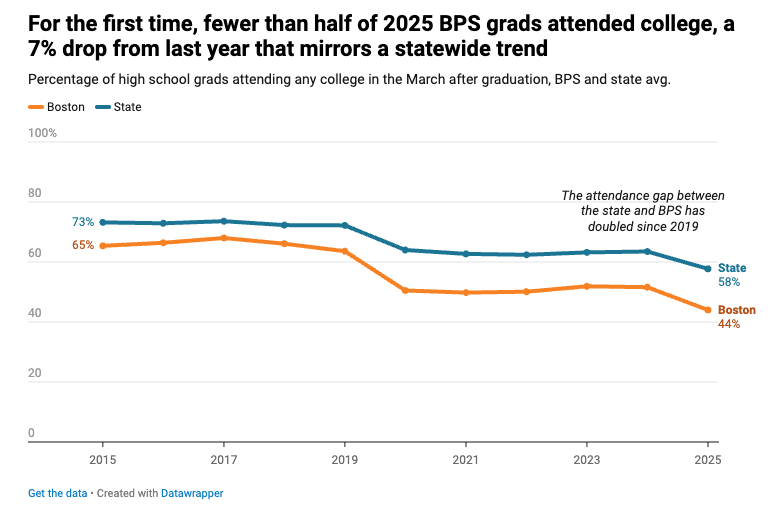
The rate of college attendance for 2025 BPS graduates dropped to 44% from 52% in 2024. College attendance among all high school graduates in Massachusetts also dropped to historic lows, down to 58% from 64% last year. After a similar decline in 2020, college attendance among BPS grads is down more than 20% since 2015. These drops occurred across every demographic and student subgroup.
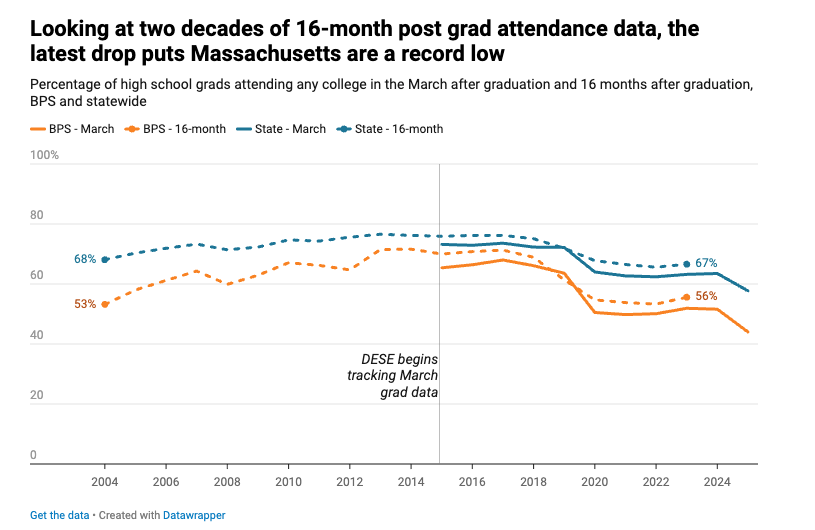
The dataset, Graduates Attending Institutions of Higher Education, uses data from the National Student Clearinghouse to survey how many high school graduates are actively enrolled in higher education, including private, public, and community colleges. DESE releases two counts for each class, one conducted in the March after their graduation, and one 16 months after graduation. March data goes back to 2015, while the 16-month data is available from 2004. While we will not have 16-month data for some time, we can assume there would be a similar drop in college attendance in that data as well.
Looking at the 16-month dataset, both BPS and state college attendance rates have moved roughly in tandem. From 2004 to 2014, college attendance rose for both the city and the state steadily. BPS was able to narrow the college attendance gap with the state significantly, rising from 53% in 2004 to 71% in 2014. This compared favorably to the state’s rate of 76% in that year. From 2014 to 2018, attendance rates plateaued. But in 2020, the pandemic upended the equilibrium, and attendance rates for statewide and BPS grads dropped 4% and 8% respectively in a single year. While attendance rates stabilized post-pandemic, the declines had essentially erased two decades of gains in college attendance. With the drop in 2025, it appears that college attendance is now at its lowest levels across Massachusetts in the 21st century.
Despite the fluctuation in college attendance overall, the type of college they enroll in has remained consistent. Over the last decade, roughly 35% have chosen a public 4-year, 40% went private, with the remaining choosing a 2-year public. Of BPS students choosing a 4-year public school, over 80% attend a University of Massachusetts or other Massachusetts college. Much like BPS, 40% of statewide grads also choose a private school. Unlike the state, BPS grads are much less likely to attend a non-Massachusetts public college. While 16% of graduates across Massachusetts attended an out-of-state public college, only 6% of BPS grads did. Attendance at Massachusetts Community Colleges after graduation has declined slightly, from 24% in 2015 to 21% in 2025. This occurred alongside the trend of increasing community college enrollment as a result of free tuition and other incentive programs. However, these programs have largely been targeted at adults over the age of 25, not high school graduates. The MASSGrant Plus program, which now covers costs for many students at all Massachusetts state universities, is likely helping to get Boston students into local public schools.
Demographic Breakdown
The 2025 drop in college attendance occurred across all student subgroups: Asian, Black, ELL, Hispanic, students with disabilities, and White students. All groups have now seen at least a double-digit decline in college attendance rate since 2019. The college attendance rate for BPS grads is now 20% lower in 2026 than in 2019, with the largest declines among Hispanic and ELL students, followed by students with disabilities and Black students. But the most recent decline shouldn’t overshadow the larger trend – the rapidly growing gap in attendance post-pandemic.
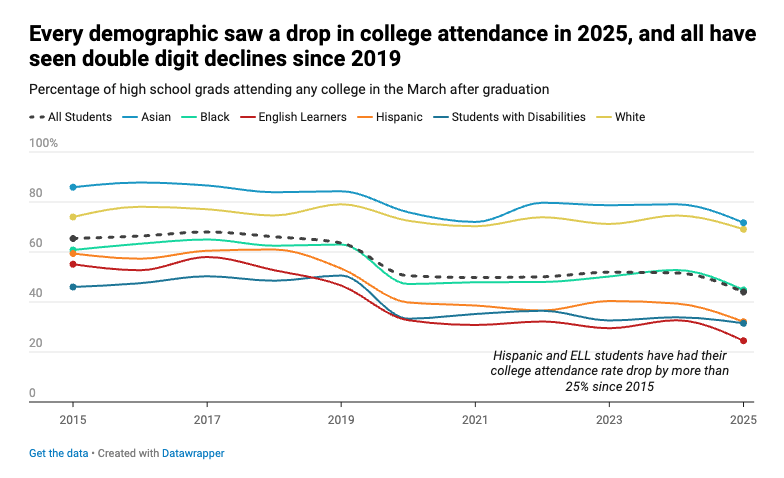
College attendance rates grew from 2004 onwards for all demographics: while just 50% of Black BPS grads attended college in 2004, that number had jumped to 67% in 2014, and students with disabilities saw a 30% increase in college attendance! This was extremely meaningful progress, and BPS succeeded in creating broad postsecondary success. Still, the gap between the groups with most college attendance and the least remained mostly static. But, as we have seen across a multitude of educational metrics, the pandemic was an inflection point. From 2004 to 2019, college attendance among White students was 13% higher than it was for Black Students, and 18% higher than Hispanic students. The gaps from 2020-2023 were 24% and 34% respectively. After more than a decade of rising tides lifting all students, achievement gaps have begun to reopen.
Even as enrollment drops, students still plan on college
In addition to post-graduation data, DESE also collects data on the intentions of high school seniors. It tracks the plans of graduates, including postsecondary education, direct employment, and military service. Statewide, 82% of seniors planned on some form of postsecondary education, 9% said they would be working, and the remaining had other or unknown plans from 2004 to 2019. Over this period, the percentage of students who planned on attending college was 10% higher than the share who were actually enrolled 16 months after graduation. With the enrollment declines after 2020, the gap between plans and college enrollment had grown slightly to 12%. But even with a significant decline in college attendance in the last year, the share of students planning on attending college actually rose slightly, from 75.8% to 76.2%. As a result, the gap between intention and enrollment grew to 18.5%, double the pre-pandemic trend.
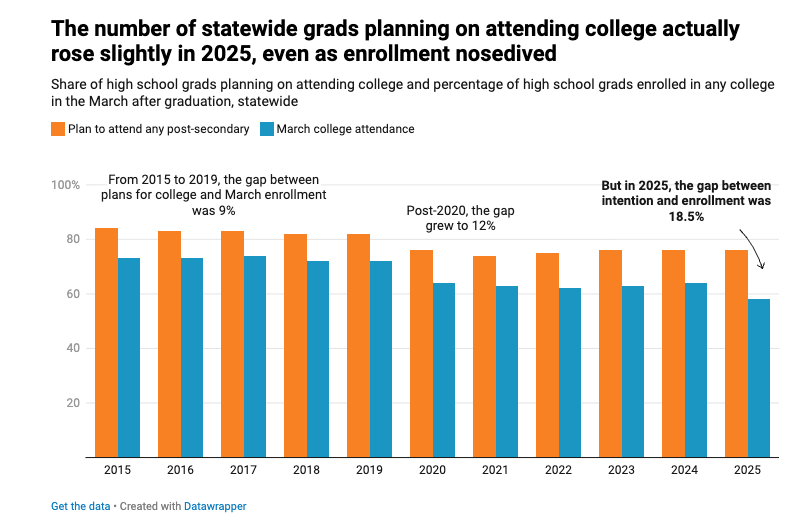
This survey should not be treated as gospel, but it provides a compelling argument against the idea that students see college as unnecessary. An overwhelming amount of students still see college in their future, and even in a year where enrollment cratered, that hasn’t changed. But the share of seniors who plan on working after graduation has increased over the last five years, suggesting that at least some students are forgoing college plans for the workforce. While data does exist for Boston, a much larger share of responses are “unknown” (up to 40%), making over-time comparisons difficult. However, the rate for Boston has been more stable over the last four years, allowing for some inferences. In 2025, 68% of students planned on attending college, a 2% decrease from 2024, and roughly the same as in 2022 (17% were unknown).
All of this suggests that in Boston, as in the rest of the state, high school seniors are still choosing college, but aren’t attending – but why? The answer may be economic. The increasing cost of higher education is no secret, and a look into the economic gap between college attendees is stark. College attendance for low-income high school grads in Boston has dropped from 63% in 2015 to just 38% in 2025. But for students who are not low income, it was unchanged over the last decade at 67%. We see the same trend and the same widening gap at the state level as well.
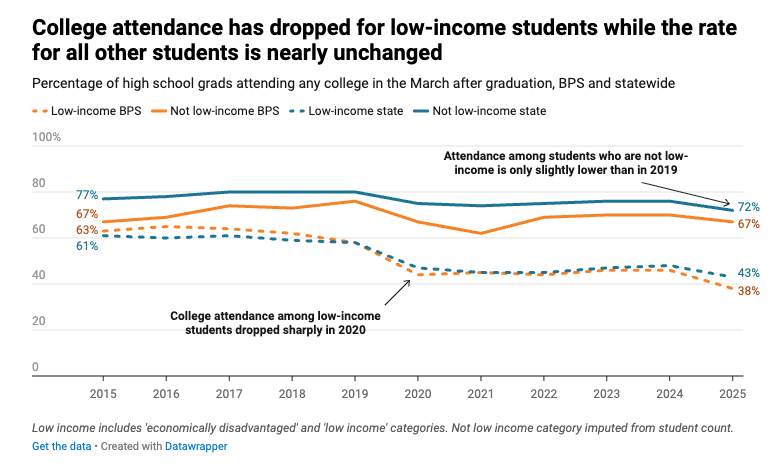
We know that low-income students have experienced disproportionately more learning loss than high-income students, which may contribute to lower college attendance. But we can see the divergence begins prior to 2020, which suggests other contributing factors. Paired with the fact that most students still plan on attending college, this suggests that the direct and opportunity cost of higher education may be behind the decline in attendance.
The question of what exactly high school grads are doing if not college is a hard one to answer. BPS, and the state, have put significant focus on increasing graduation rates over the last few years. As we discussed previously on the podcast, Boston specifically has been graduating students who may have not done so in years past. This might suggest that the new students graduating are less prepared for college. While a possible explanation, Boston’s graduation rate had increased steadily from 2013 to 2021 alongside college enrollment rates. It is possible that graduating more students depresses college attendance, but there’s no clear correlation and it wouldn’t explain the sharp drop in 2025.
The share of students who planned to work after graduation has risen slightly over the last decade to around 10 to 15%. But that clearly understates the actual total given the actual college attendance data. DESE does collect post-graduation wage data, which could give some clues to employment. However, this depends strictly on data from Massachusetts agencies, limiting its reach. Critically, data from the last five years suffers from high non-response and severe methodological issues that make it nearly impossible to rely on. The loss of young people in Massachusetts as a result of high costs of living has been a hot topic of discussion. The growing number of non-college attending high school grads may in part be due to people in the workforce leaving the state. This may also explain the increase in non-response issues in the datasets.
Looking to the future
The 8% year-over-year drop in college attendance for BPS grads is shocking, and worthy of further investigation. The large drop may be a one-off, but the trend of declining college attendance post-2020 is impossible to ignore. To be sure, not every student needs to attend higher education immediately after graduation. But at the same time, the district has made it a point to increase graduation rates and college preparedness, even as reports have called into question how effective these efforts have been. The graduation rate is higher than ever, but the divergence in college attendance, especially among the least resourced students, calls into question if these efforts are enough on their own. Especially as students seemingly still say they want to attend college. But the trend is occurring across Massachusetts, not just in Boston. These issues are impacting students everywhere, it’s unlikely any one thing BPS does will fix it. It calls for a broader response to examine what exact headwinds are facing students and perhaps a reexamination of higher education as it exists today.