Record High, Record Low: BPS Buses Had the Best and Worst Month on Record This Year | Last Night at School Committee: May 6th, 2026
The best of bus times, the worst of bus times
The school committee briefly touched on BPS’s bus transportation performance, continuing to claim ‘great strides’ in addressing structural issues with the troubled system. This was particularly relevant given the need for additional funds to cover overspending on transportation in the current fiscal year. Remember that next year, BPS has budgeted $199M, roughly $50 a day per student transported.
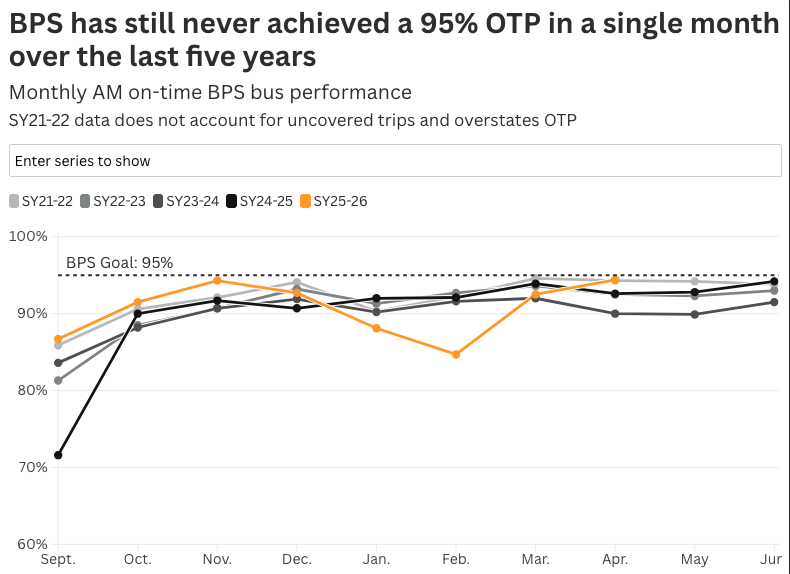
April indeed was the best of times – 94.4% of AM buses arrived on-time, which is the best monthly performance on record. However, this does still fall short of the 95% on-time performance (OTP) goal set by the district and state in 2022. And it was somewhat overshadowed by what could only be called catastrophic bus performance to start the year: January OTP was 88.1% and February was 84.7%, one of the worst months on record. As it did in the February report, BPS blamed snowfall for the deteriorated OTP in the first two months of the year. While the past few years have seen little snow, it’s worth noting that the substantial January 2022 blizzard (23.5 in.) did not appear to impact OTP nearly as much. Regardless, March also saw a lower OTP than years prior despite a lack of snowfall. Year-to-date AM OTP is 90.7%, the highest on record by 0.2%.
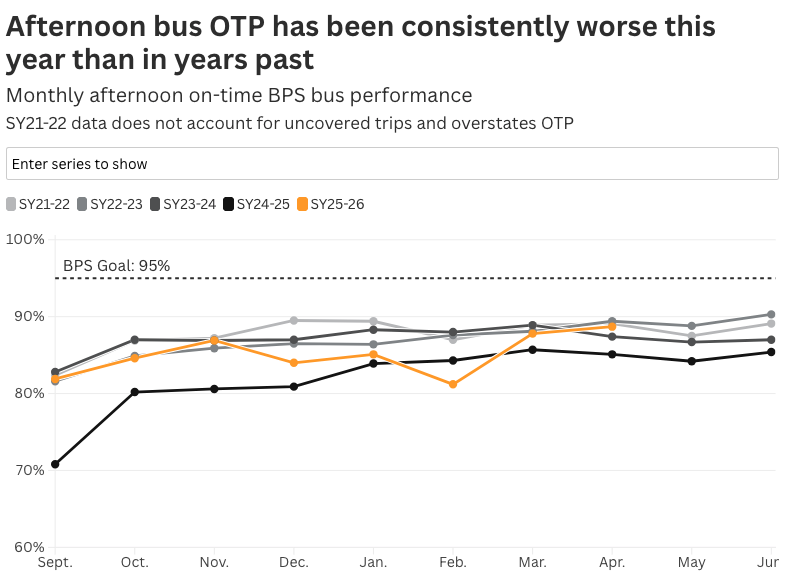
Afternoon data was similarly varied, seeing some of the highest and lowest OTPs on record in April and February respectively. Interestingly, January’s PM OTP was slightly higher than in December, in stark contrast to the snow-impacted AM performance. However, afternoon performance has been worse overall. The year-to-date OTP of 85.1% is lower than both 2022-23 (86.3%) and 2023-24 (87%). This raises serious questions about what structural improvements are actually taking place, and if BPS and Transdev can deliver on their promises.
For the first time in its current contract with Transdev (since 2023), BPS fined the vendor $105,000 for missed trips. Despite being allowed to do this, and Transdev failing its contractual obligation every month since the contract was inked, the district has not exercised that right until now. Although it’s not quite as drastic as it seems: the fine represents around 7% of its $1.6M monthly payment. WBUR also reported that per the contract, BPS could have imposed more than $1,500,000 for all missed trips in the current school year. BPS said in its 2025 transportation report that it runs ~3,000 daily trips, and that in the last three years an average of 0.2% of trips were uncovered. At $500 per missed trip, we can calculate that BPS has forfeited an additional $1,000,000 in fines from 2023-2025. The actual punishment has thus been relatively light, and it remains to be seen if it will result in meaningful improvement.
Putting the budget in context
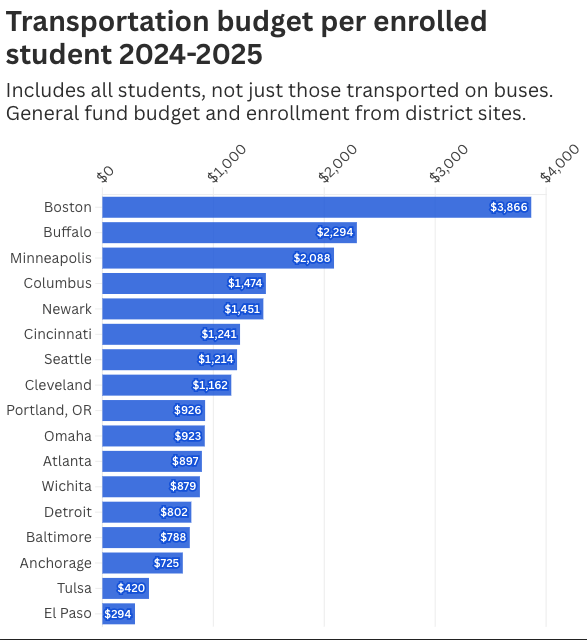
And while BPS’s buses continue to struggle, it is important to remember how much Boston pays. BPS budgeted $178M for transportation, more than 11% of the total operating budget. Looking at comparably sized urban public districts with school bus transportation, only Minneapolis (7.8%) and Columbus (7.1%) come close in terms of budget allocated to transit. On a per student basis (accounting for total enrollment, not just the number of students actually transported), Boston spent $3,866 per student. This was by far the most in the dataset, and more than 70% higher than the next school (Buffalo). Boston pays far more to get far less for transportation.
The National Center for Educational Statistics (NCES) has recently released some national data on school finances. While only covering the 2023-24 school year, it provides a comprehensive look at school spending across the country. Looking at comparable urban districts, BPS’s per-student spending stands out at nearly $37,000, more than any other district. Only DC Public Schools at $32,000 per student approaches BPS’s total. Even San Francisco, famed for a high cost of living and public spending, spent only $23,000 for each of its 48,000 students. The data also breaks down spending by rough category. BPS spends an average amount of its budget on instruction (teacher compensation, educational supplies), but significantly more than average on transportation.
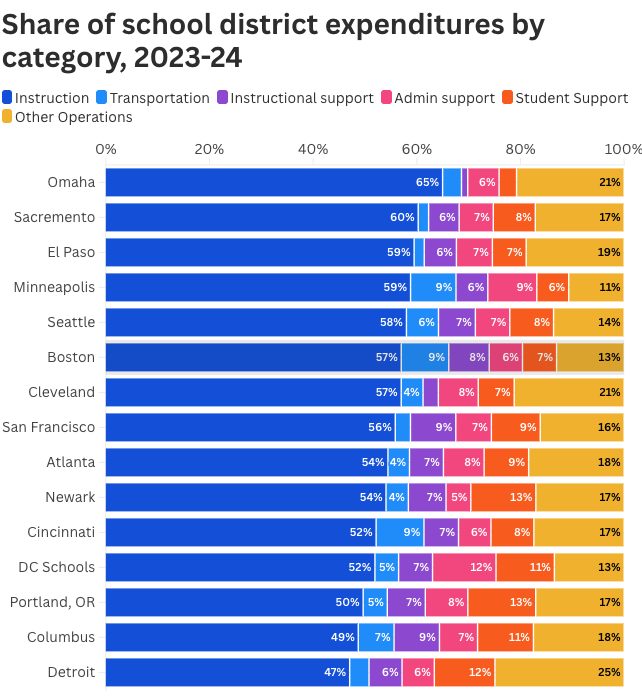
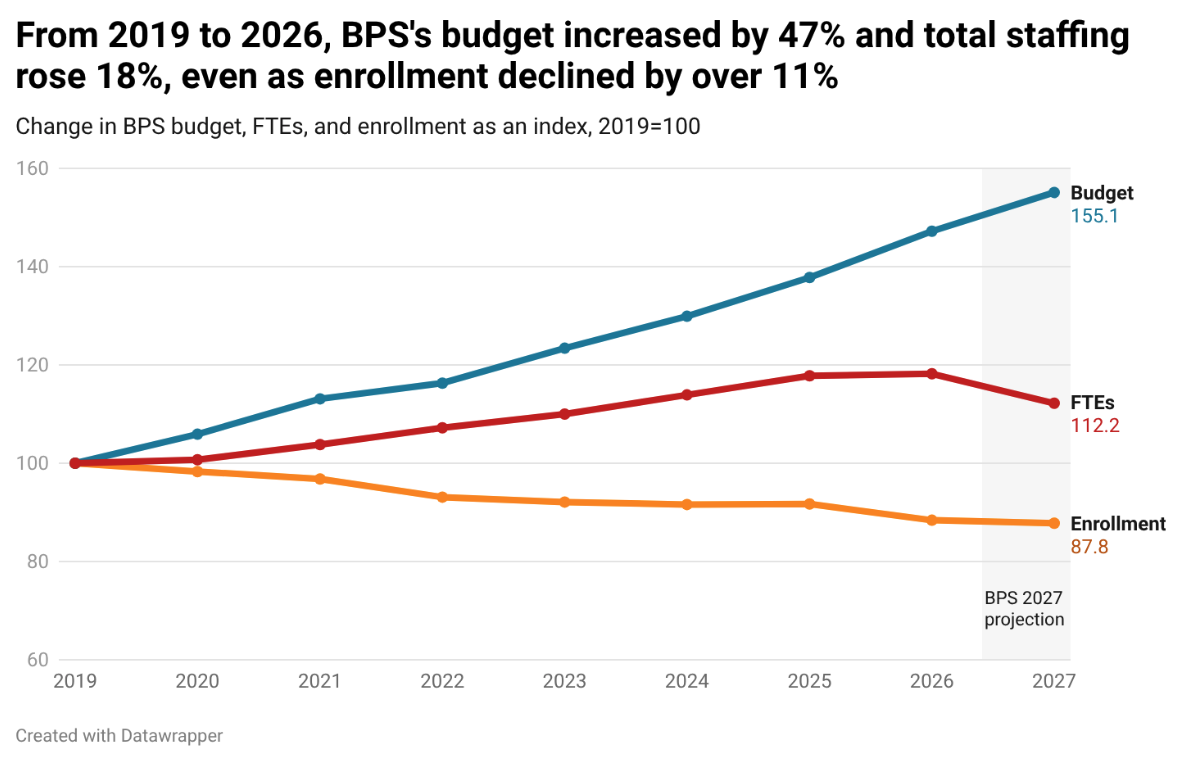
Despite an operational deficit and falling enrollment, BPS’s spending continues to increase mostly unabated. In 2027, the budget will be $1.73 billion, up from $1.1 billion in 2019, a more than 55% increase. Even accounting for inflation, that’s a 20% budget increase at the same time that enrollment fell more than 11%. Staffing has followed a similar trend, with the total number of positions up 12% in 2027 compared to 2019. BPS has cited health insurance costs as a key driver of its budgetary woes but even after cuts, the district still employs more staff than it did in 2024. Even with its reluctance to cut the budget, the current pace of spending paired with historically low enrollment is unsustainable.