
Last Night @ School Committee

A bite-sized summary of Boston School Committee meetings, and "Deep Dives" on the biggest issues impacting public schools nationwide.


Last Night at School Committee - July 8, 2026
Last night's School Committee meeting kicked off with some key updates from Superintendent Skipper. She started off by breaking down the district’s plan to cut around 568 positions. She explained this is a direct response to losing roughly 3,000 students over the last two years, though she promised a steady 10-to-1 student-to-teacher ratio would remain. The Superintendent also touched on summer programming across the district, including the statistic that thousands of students are enrolled in credit recovery, which she framed as a positive sign for students, even though this would mean that more students are failing courses. Skipper also announced that Boston is joining the massive nationwide lawsuit targeting tech giants like Meta, TikTok, and other corporations for harming kids' mental health through social media. During public comment, the only two speakers of the night called out the district for withholding promised exam school outcome data and demanding clear, measurable goals to track student success. Later on, the Committee conducted a marathon voting session, voting on and approving 19 items! These include collective bargaining agreements, grants, private school applications, evaluations, and appointments.
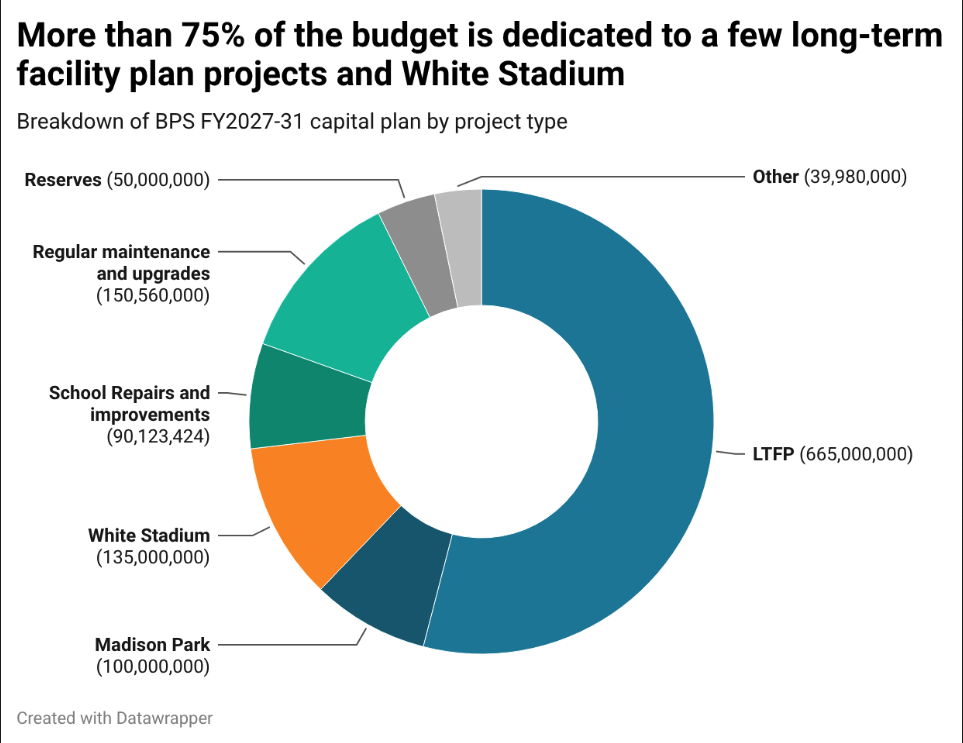
The district's changing infrastructure and facilities footprint dominated the rest of the night. Chief of Capital Planning, Delavern Stanislaus, noted that the district aims to downsize from its original 114 schools to an even 100 by the end of the 2026–2027 school year, with a final target of 95 schools by 2030.
Tools
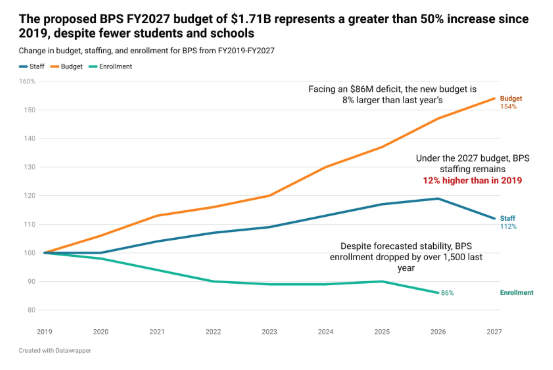
The 2027 proposed budget for Boston Public Schools is over $1.7B, providing funding for over 10,000 employees responsible for more than 46,000 students across 105 schools. Comprising over 40% of the city’s budget and shouldering responsibility for educating tomorrow’s leaders, understanding the changes in the budget are crucial. The district makes many of its financial documents publicly available, although not always in an accessible or easily understandable format. The tool below combines multiple sources of data (chiefly the FY27 budget sheet and the budget book) in an easily browsable format to help students, teachers, policymakers, and concerned citizens to understand the changes in the coming fiscal year.
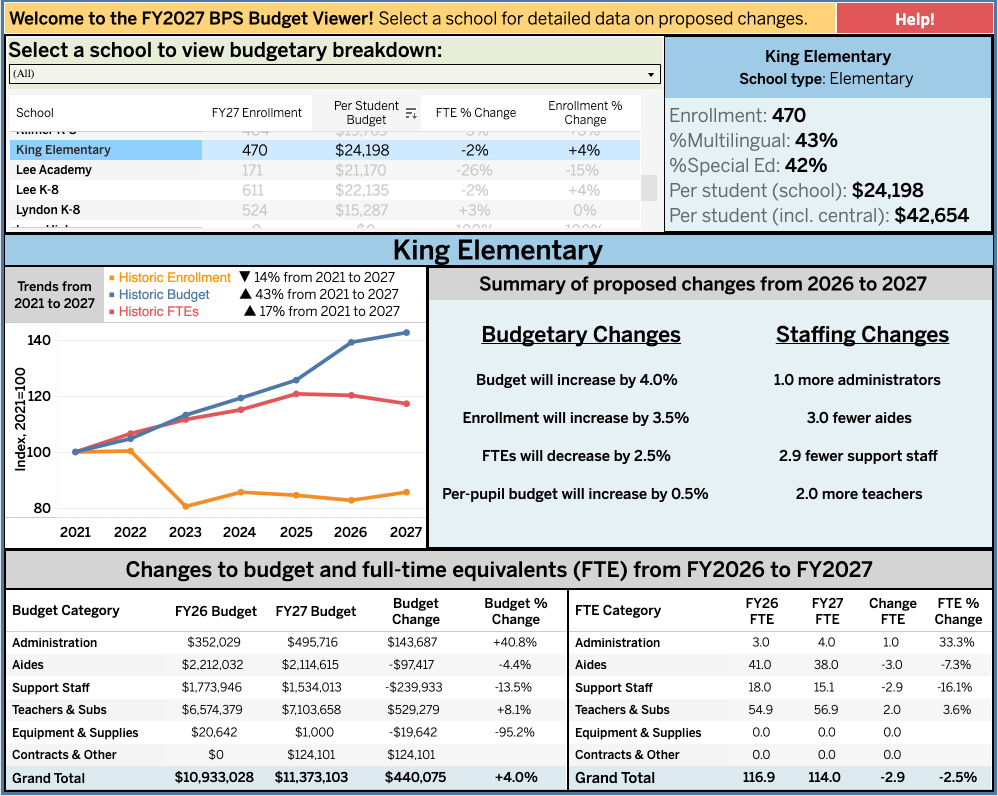
School Database allows you to explore enrollment, budget, and staffing changes for individual schools from 2026 to 2027. The dashboard shows district-wide changes, and searching for or clicking on individual schools in the list will bring up school-specific data.
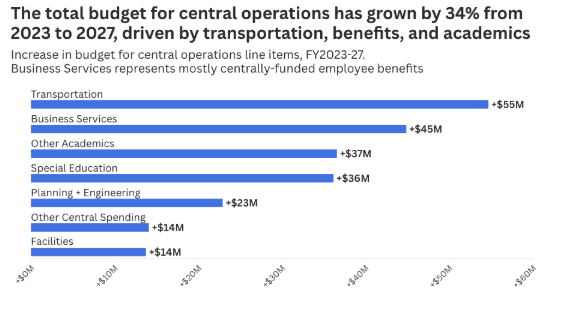
BudgetBreakdown details how the FY2027 budget is spread between direct school funding and central office funding, and how each broad category and specific line item is changing. Hovering over each box provides more information, and filters on the right allow for a closer view.
Budget Over Time will detail how each broad budget category has changed since 2019, and which portions of the budget have grown the fastest.

Methodology
Numbers may vary slightly from sources elsewhere. While it may be an error, it’s also possible that the underlying data has variations from source-to-source. As this tool attempts to unify disparate sources across times and departments, variation is a given. Some of the more common questions sources of inconsistency:
School inclusion: BPS, in its budget, includes a number of in-district charters (Boston Day and Evening Academy, Green Academy, Dudley Street Neighborhood School, and the Kennedy Academy for Health Careers) which are sometimes excluded from datasets. Given that these are funded and staffed by BPS, they are included here. School names and formats change over time, and while we strive to be consistent, this can create confusion.
Enrollment: This total varies based on when the students are counted, and totals in the beginning and end of the year may vary. As mentioned above, the inclusion of in-district charters can also add several hundred students.
Budget: We use the most recent FY27 budgets, but these are still subject to change and may vary between draft budgets. For historic budgets, we use current spending levels as opposed to adopted budgets, which can lead to variation.
Budget category: To create cross-time comparisons in the budget breakdown, we have attempted to group central budgeted functions as they are in the FY27 budget, as they were grouped differently in years past. These groups are unofficial, and while all individual line items remain as they appear, the category in which they appear may be unexpected.