
Last Night at School Committee: March 4, 2026 Central Office Budget Recap
Last Night at School Committee - March 4, 2026:
On Wednesday evening, the district held a hearing focused on the Central Office budget. In their presentation, district leadership stated that they prioritized "student-facing" investments that directly supported schools. Highlights from the central office budget include an $86 million increase due to four main categories: health insurance, transportation expenses, special education, and collective bargaining. More specifically, transportation saw a year-over-year rise of 9%, and special education saw a significant jump of 22%. The district was able to find some operational efficiencies in the budget. For instance, they were able to reduce the number of staff at the central office, thus saving $11 million for FY 27. Nevertheless, there are significant financial outlays in the district’s budget that hamper the impact of these minimal savings.
During the public comment period of the hearing, there were 38 public speakers, many of whom were concerned about the impact of staffing cuts on student life and experience. School committee members then pushed the district to respond to questions about cuts to paraprofessional staffing levels, the enormous cost of transportation, and how student outcomes align with the budget. The budget process will continue with a final hearing on March 18, followed by a School Committee vote on March 25, before heading to the Boston City Council for final appropriation.
Check out our analysis of the BPS Central Budget below:
Central Budget Overview:
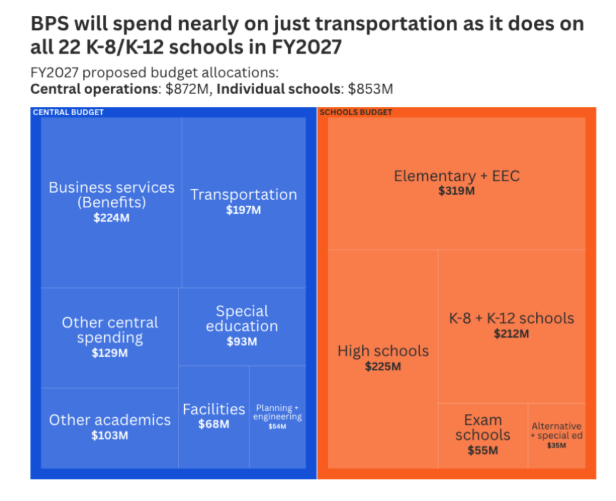
The proposed FY2027 budget for Boston Public Schools is $1.71B, a 4.5% increase from current spending levels, and 8% higher than the budget passed in 2026. The BPS budget is divided between ‘Central’ and ‘School’ spending, with the former representing district operations and centrally-budget services like transportation or special education, and the latter representing individual school budgets and teacher salaries. Much of the central budget does represent funds that go to students in schools, which the district refers to as ‘Centrally Funded Directed to Schools.’ While worth keeping in mind, this distinction can complicate comparisons, and in this document, central spending will refer to spending under ‘Departmental Detail’ in BPS budget tables such as this unless otherwise noted. (1) Central spending represents a significant and growing slice of the total budget. BPS plans to spend $873M on central operations, a 10% increase from current spending levels, and $853M on schools, a 1% decrease from current spending levels. For the first time, the total central budget will eclipse total school spending. Much of this increase comes from a 23% rise in budgeting for ‘Business Services’, which represents mostly employee benefits. Benefits specifically(2) are rising by $40M, driven by a $34M increase to health insurance costs. The district has pointed to employee benefits as the largest driver of the deficit and persistent budgetary woes, which have impacted municipalities and districts across the United States. In large part, this is driven by excess hiring and the district choosing to significantly increase FTEs over the last five years even in the face of declining enrollment. But while benefits represent a large portion of the increase for the coming fiscal year, they do not explain a majority of the growth in central spending.
 (1)Totals for FY27 represent proposed and not final decisions, but proposed budgets have historically been very representative of final budgets.
(2)  Found here, or in the account category of the budget tables.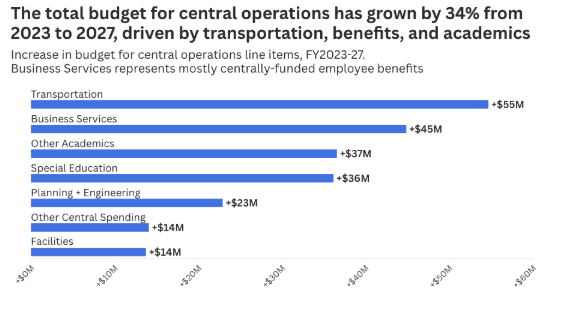
Central spending has grown by $223M (34%) from the FY2023 budget to the current budget proposal. But spending on business services only accounts for $44M or a fifth of that growth over the last five years. In fact, spending on transportation increased by $55M over that period – more than benefits! Benefits also do not make up a particularly high proportion of central spending, even in 2027. Business services comprises 26% of all central spending in FY2027, which is still lower than in 2023 when it made up 28% of spending! Even pre-pandemic, business services represented over 29% of central spending in FY2019, far more than they will in the coming year. Even if spending on benefits held steady, BPS would likely still be facing significant budgetary headwinds. The District's budget problems cannot be ascribed solely to ‘unpredictable’ health insurance cost increases; the deficit must be discussed in the context of years of broad budget growth.
Transportation, in particular, is a concerning budget item as it is the second largest expenditure for the central budget behind benefits and is one of the few budgetary items to see an increase even in a deficit year. At a predicted $198M for FY2027, it represents among the largest slices of the budgetary pie. BPS plans to spend nearly as much on bus transportation for 22,000 students (3) as it will on K-8 schools, high schools or centrally budgeted academic programs like special education and early childhood. Here again, the district has offered a number of explanations for the cost increases, but an examination of the data shows that it is not simple.
(3) Rough estimate per the 2022-25 Transportation Progress Report. Despite Public Records requests, BPS asserts it does not store the data necessary to report current ridership totals.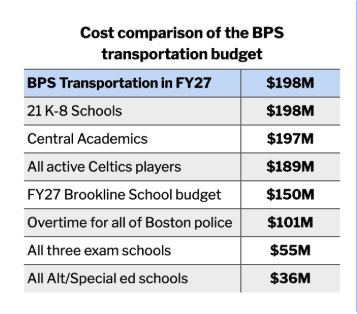
Transportation Budget Overview:
In 2022, Boston agreed to a Systemic Improvement Plan with the state and DESE which covered all aspects of BPS’s operations, including transport. At the time, the city and district agreed “to undertake the initiatives outlined below and to be held accountable for reaching specific, identified goals on a clear timeline” over the next three years, ending in June of 2025. For transportation, it included a mandate to achieve 95% on-time performance and an evaluation to analyze efficiency and cost of the transportation department. The district released a mostly positive report on the state of transportation in April of last year, and in a February 2026 School Committee meeting, the district stated: “Since 2022, BPS has made significant progress in addressing many of the long-standing structural issues impeding transportation improvements, leading to measurable, sustained improvements in on-time performance.” While the district has undoubtedly made progress, it has failed to uphold its commitment to the specific targets it agreed to. Moreover, the district has failed to control costs of transportation despite years of promises.
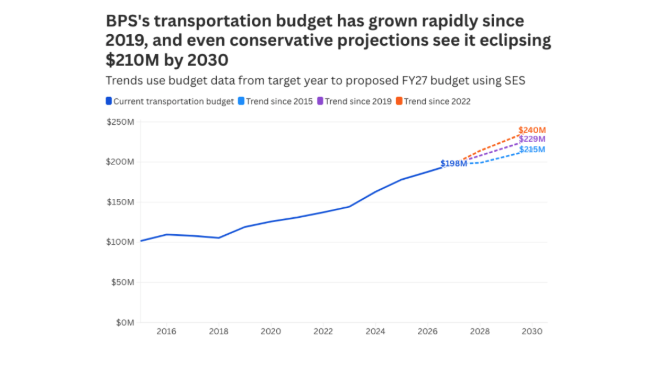
While BPS enrollment is more than 45,000, only about 22,000 students were transported by the district last year. Still, the transportation budget has grown substantially over the last decade. In 2015, BPS budgeted $101M for transportation, representing 10.4% of the total budget. In the proposed 2027 budget, transportation spending will rise 5% to $198M, representing 11.6% of the total Boston Public Schools budget. This is after more than $10M of savings from ‘operational efficiencies’ implemented in the coming year. This budget represents a 95% increase since 2015 and a 65% increase since 2019. From 2015 to 2027, transportation spending has grown by an average of 5.8% per year, outpacing total budget growth (4.8%). That gap has grown considerably since the pandemic – the transportation budget has increased by 7.3% annually since 2022, compared to the total budget’s growth rate of just 5.1%.
The April 2025 transportation report states that “Budget growth will slow and the transportation budget will decline as a percentage of the BPS Operating Budget.” Notably, the district makes no claim that the budget will decline, just that the rate of increase may slow. The line chart on this page shows the growth of the transportation budget since 2015, with the dotted lines indicating projections based on various trends. Based on the 2015-2027 budget trend, transportation spending would rise to $212M by 2030, which would be an average growth rate of just 2.5% – half the current rate. Continuing the 2019 trend would result in a budget of $226M, while a continuation of the trend since 2022 results in a nearly $240M budget. All of these projections would have lower average growth rates than what the district has seen since 2019. Even if transportation declined to the same share of the budget as it had in 2015 (10.4%), it would still be $178M in 2027, the same as it was budgeted for in 2025.
Despite repeated promises about the impact of school closures, declining enrollment, new contracts, and technical innovations, the District has failed to slow the growth of the transportation budget. Even the most optimistic cases predict transportation to remain a major cost driver, even as the district fails to meet its performance expectations and is forced to cut costs elsewhere.
To read more about the transportation budget, please click here.